In the hierarchy of control of gaseous pollutants, combustion control (or thermal oxidation) is often the final and most effective line of defense. Unlike filtration or scrubbing which merely transfer pollutants to another medium, combustion chemically destroys Volatile Organic Compounds (VOCs), converting them into harmless CO2 and water vapor.
At ABOUT US, we design our thermal oxidizers around strict combustion dynamics to ensure complete destruction efficiency (DRE) exceeding 99%.
1. The “3T” Principle in Combustion Control
Effective combustion control relies on three fundamental parameters, known as the “3Ts.” Cadair’s equipment is engineered to optimize each:
- Temperature: The combustion chamber must reach a specific setpoint (typically 760°C – 850°C for VOCs) to break chemical bonds. Our RTO systems maintain this heat with minimal fuel by using ceramic heat recovery.
- Time (Residence Time): Pollutants must stay in the high-temperature zone long enough to react fully. We typically design for a residence time of 0.5 to 1.0 seconds, ensuring no “short-circuiting” of unburned gases.
- Turbulence: Proper mixing of air and fuel is vital. Our burner designs ensure high turbulence, eliminating cold spots where VOCs could escape untreated.
2. Equipment for Combustion Control
Different exhaust streams require different combustion technologies for optimal control of gaseous pollutants:
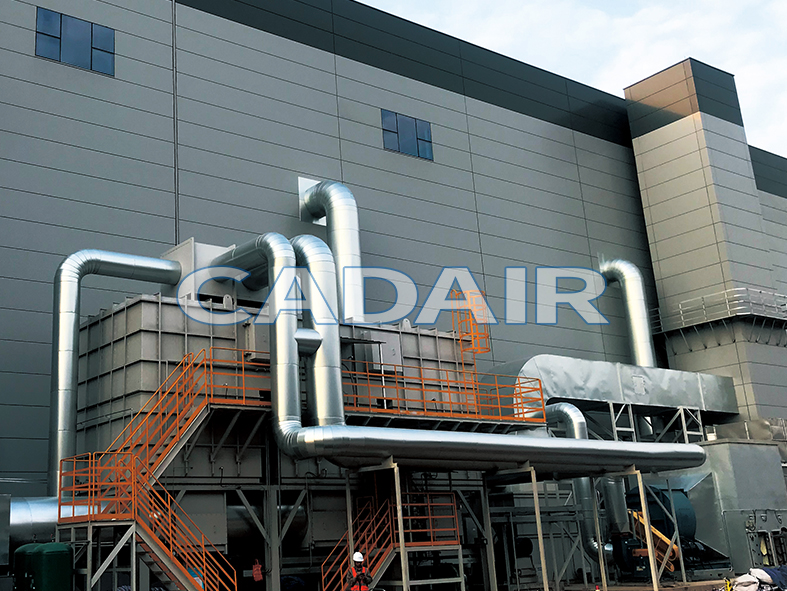
- Regenerative Thermal Oxidizers (RTO): The standard for energy efficiency. It uses cyclic combustion control to recover 95% of heat, making it ideal for low-concentration streams.View Product: RTO
- Direct Fired Thermal Oxidizers (TO): For high-concentration waste gas, the “combustion control” strategy changes. Here, the waste gas itself acts as the fuel. Our TO/MS-DFTO units feature multi-stage firing to handle these calorific loads safely.
3. Balancing Combustion: Controlling NOx
A critical aspect of control of gaseous pollutants combustion control is preventing secondary pollution. High-temperature combustion can generate Nitrogen Oxides (NOx).
Cadair addresses this through:
- Low-NOx Burners: Specialized burner heads that stage air injection to reduce peak flame temperatures.
- Flameless Oxidation: In our RCO systems, we use catalysts to lower the operating temperature to ~350°C, virtually eliminating thermal NOx formation.
Conclusion: Science-Backed Engineering
Effective combustion control is not just about burning gas; it is about precision engineering. Trust Cadair to deliver systems that master the physics of combustion for your compliance.
Analyze Your Combustion Needs Send us your waste gas data. Our engineers will calculate the optimal residence time and temperature for your facility.