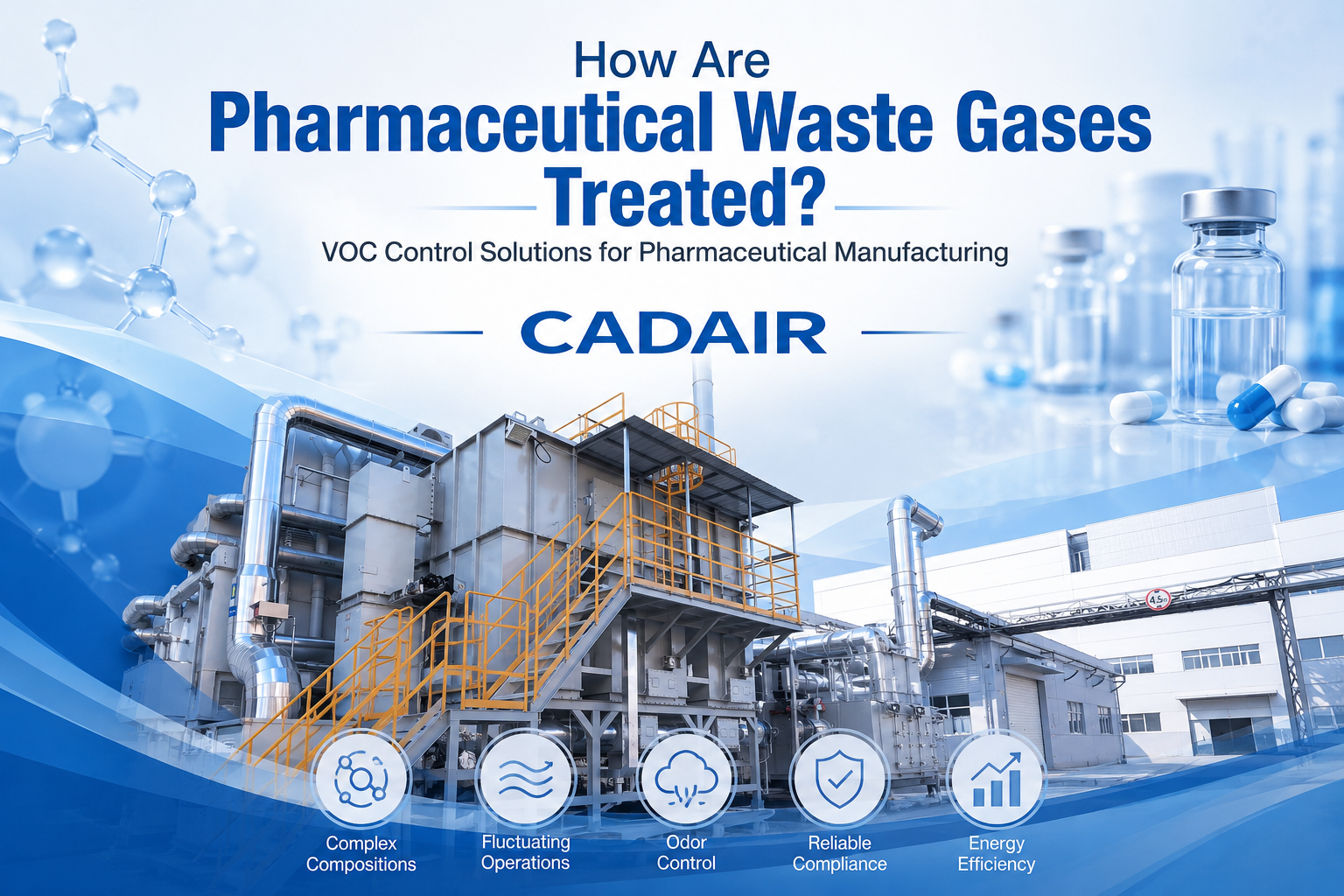
Pharmaceutical manufacturing is one of the most heavily regulated industries for volatile organic compound (VOC) emissions. Compared with many industrial sectors, pharmaceutical exhaust gas is characterized by highly complex pollutant compositions, significant fluctuations in operating conditions, strong odors, and in some cases corrosive or toxic substances.
Because pharmaceutical production processes vary greatly, there is no universal VOC treatment solution. Effective emission control requires customized technologies based on exhaust composition, airflow volume, concentration, and production characteristics.
Why Pharmaceutical VOC Emissions Are Challenging
1. Complex Pollutant Composition
Pharmaceutical production involves a wide variety of solvents, intermediates, and auxiliary chemicals.
Typical VOCs include:
- Ethanol
- Isopropanol (IPA)
- Acetone
- Ethyl acetate
- Butyl acetate
- DMF
- Benzene, toluene, and xylene (BTX)
- Chlorinated hydrocarbons
In addition to VOCs, exhaust streams may contain:
- Pharmaceutical dust
- Acid or alkaline mist
- Sulfur-containing compounds
- Nitrogen-containing compounds
- Odorous substances
As a result, a single treatment technology is rarely sufficient. Most pharmaceutical facilities require a combination of pretreatment and end-of-pipe treatment systems.
2. Large Fluctuations in Operating Conditions
Many pharmaceutical plants operate in batch production mode.
During different stages such as:
- Feeding
- Chemical reaction
- Distillation
- Centrifugation
- Drying
VOC concentrations and airflow volumes can vary dramatically.
Some workshop ventilation emissions may be below 100 mg/m³, while reactor vent gases and solvent recovery systems may exceed 10,000 mg/m³.
This requires VOC treatment systems with excellent resistance to concentration and flow fluctuations.
3. Significant Odor Emissions
Many pharmaceutical solvents and fermentation by-products have extremely low odor thresholds.
Even small quantities of emissions can generate noticeable odors, leading to environmental complaints and regulatory pressure.
4. Corrosive and Toxic Components
Certain pharmaceutical exhaust streams contain:
- Chlorinated solvents
- Nitrogen-containing compounds
- Sulfur-containing compounds
During thermal oxidation, these substances may generate:
- Hydrogen chloride (HCl)
- Nitrogen oxides (NOx)
- Sulfur dioxide (SO₂)
Additional corrosion-resistant materials and downstream purification systems may be required.
VOC Characteristics by Pharmaceutical Production Process
Chemical Synthesis Pharmaceuticals
Typical pollutants:
- Ethyl acetate
- Butyl acetate
- Acetone
- DMF
- Aromatic hydrocarbons
Characteristics:
- Complex VOC mixtures
- High concentration process vents
- Large airflow workshop exhaust
- Significant fluctuations
Fermentation Pharmaceuticals
Typical pollutants:
- Ethanol
- Butanol
- Acetone
- Ammonia
- Hydrogen sulfide
- Organic acids
Characteristics:
- High humidity
- Large airflow
- Low concentration
- Strong odor
Pharmaceutical Formulations
Typical pollutants:
- Ethanol
- IPA
- Acetone
Characteristics:
- Relatively stable operation
- Medium airflow
- Low to medium VOC concentration
Traditional Chinese Medicine Extraction
Typical pollutants:
- Ethanol
- Methanol
- Terpenes
- Aldehydes and ketones
Characteristics:
- Strong characteristic odors
- Variable concentrations
- Aerosol-containing exhaust streams
Which VOC Treatment Technology Is Best for Pharmaceutical Plants?
The answer depends primarily on airflow volume and VOC concentration.
RCO for Medium-to-High Concentration Exhaust
Regenerative Catalytic Oxidation (RCO) is suitable for:
- Medium airflow
- Medium-to-high VOC concentrations
- Solvent-dominated exhaust streams
Advantages:
- Thermal recovery efficiency above 95%
- Lower operating cost
- High VOC destruction efficiency
- Stable long-term operation
Zeolite Rotor Concentration Systems for Large Air Volume Exhaust
Zeolite Rotor Concentration technology is suitable for:
- Large airflow
- Low VOC concentration
- Complex solvent mixtures
Advantages:
- 10–20× concentration ratio
- Significant reduction of downstream oxidizer size
- Improved energy efficiency
- Excellent adaptability to fluctuating operating conditions
Case Study: Grand Pharma Pharmaceutical VOC Treatment Project
Project Overview
Grand Pharma is a leading pharmaceutical manufacturer specializing in respiratory therapies and innovative drug development.
Location:
Beijing, China
Design Airflow:
8,000 m³/h
Exhaust Characteristics:
- Ethanol-based solvent emissions
- Medium-to-high VOC concentration
- Relatively simple pollutant composition
Treatment Solution
CADAIR implemented:
Pretreatment + Three-Bed RCO System
The regenerative catalytic oxidation unit utilizes ceramic heat storage beds with heat recovery efficiency exceeding 95%.
Under catalytic oxidation conditions of approximately 350°C, ethanol VOCs are completely decomposed into carbon dioxide and water.
Results
- Stable operation exceeding 730 consecutive days
- Non-methane hydrocarbons below 20 mg/m³
- Compliance with pharmaceutical emission standards and Beijing local requirements
- Reduced operating energy consumption through efficient heat recovery
Case Study: Guilin Pharma VOC Emission Control Project
Project Overview
Guilin Pharma, a member of Fosun Pharma, is one of the world’s major manufacturers of antimalarial pharmaceutical products.
Location:
Guilin, Guangxi, China
Design Airflow:
56,000 m³/h
Exhaust Characteristics:
- Ethyl acetate
- Butyl acetate
- Acetone
- DMF
- Aromatic hydrocarbons
Large airflow and low concentration VOC emissions from chemical synthesis and formulation production.
Treatment Solution
CADAIR implemented:
Zeolite Rotor Concentration System
The zeolite rotor continuously adsorbs and concentrates VOCs before transferring them to downstream oxidation equipment.
The concentration ratio can reach 10–20 times, significantly reducing energy consumption and equipment footprint.
Results
- Stable treatment of multi-component VOC streams
- Adaptation to frequent production fluctuations
- Improved energy efficiency
- Reliable compliance with emission standards
Choosing the Right Pharmaceutical VOC Treatment Solution
There is no universal technology suitable for all pharmaceutical facilities.
In general:
| Exhaust Characteristics | Recommended Technology |
|---|---|
| Medium-to-high concentration, small airflow | RCO |
| Low concentration, large airflow | Zeolite Rotor Concentration |
| Complex mixed pollutants | Customized multi-stage system |
| High humidity fermentation exhaust | Pretreatment + odor control + oxidation |
The most effective pharmaceutical VOC control strategy begins with detailed analysis of solvent composition, concentration, airflow volume, and production processes.
With extensive experience in pharmaceutical, chemical, semiconductor, battery, and advanced manufacturing industries, CADAIR provides customized VOC treatment systems that combine environmental compliance, operational reliability, and energy efficiency.