I. Project Overview & Retrofit Background
Rianlon (Zhongwei) New Materials Co., Ltd., based in Zhongwei, Ningxia, specializes in polymer functional additives production. Its synthesis section continuously discharges mixed organic waste gas containing halogenated hydrocarbons. The original RTO units suffered severe furnace and pipeline corrosion from acidic media generated by high-temperature oxidation of halides, resulting in short equipment lifespan, high O&M costs, and dual pressures of emission compliance and continuous production assurance.
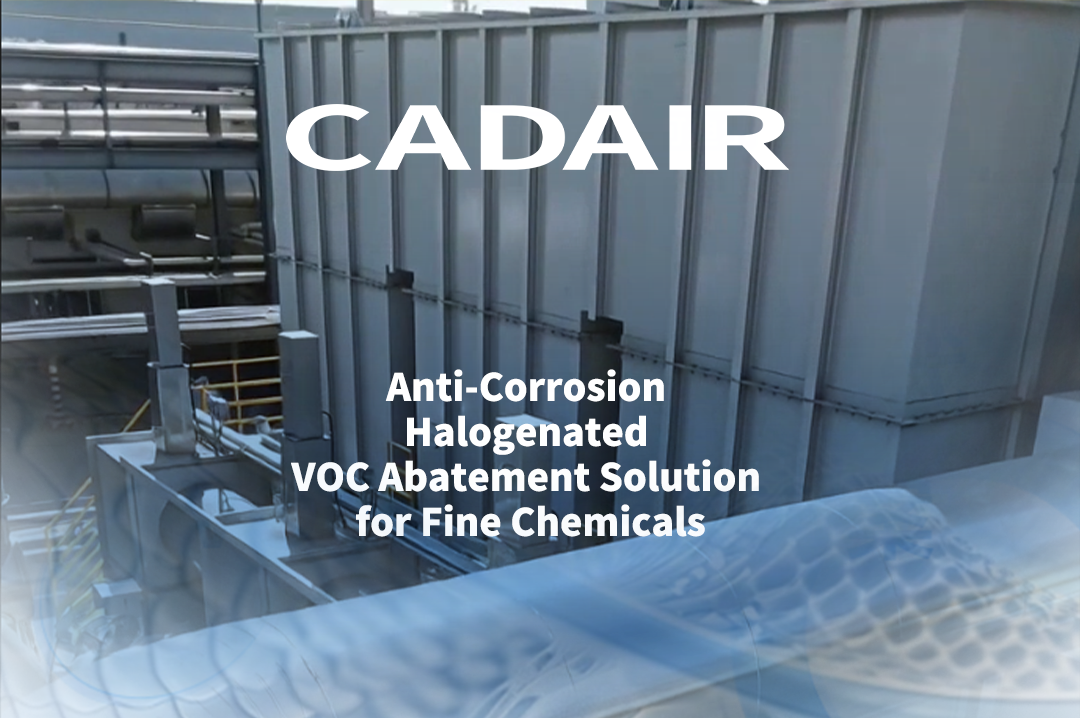
CADAIR retrofitted the on-site waste gas treatment system and added one three-bed RTO, forming a mutual-backup setup with the two existing RTOs. The three process trains support flexible switching to secure year-round production, with a designed ≥99% purification efficiency.
Basic Operating Parameters
- Design treatment air volume: 35,000 Nm³/h
- Inlet VOC concentration: ≤4,000 mg/m³ (large component fluctuation); inlet relative humidity ≤75%
- Core components: toluene, xylene, methanol, o-dichlorobenzene, methylene chloride, etc., with trace HCl and ammonia; halogenated hydrocarbons are the primary corrosion source
- Operation mode: 24h × 365 days continuous running
- Core challenges: HCl from halogenated hydrocarbon oxidation causes equipment corrosion and perforation; impurities easily clog regenerative media; the solution must simultaneously deliver high purification, long-term anti-corrosion and production continuity.
II. Design Basis & Applicable Standards
All process and equipment design strictly complies with national and industrial specifications, and the compliance documentation is eligible for EIA filing and environmental acceptance:
- Occupational Exposure Limits for Hazardous Agents in the Workplace
- Code for Design of Low-Voltage Power Distribution Systems (GB 50054-2011)
- Code for Design of Power Distribution for General Electrical Equipment (GB 50055-2011)
- Code for Design of Signal Alarm and Interlock Systems (HG/T 20511-2014)
- Setting and Selection of Bursting Discs (HG/T 20570.3)
- Code for Design of Static Electricity Grounding in Petrochemical Industry (SH 3097-2000)
- Code for Design of Building Fire Extinguisher Configuration (GB 50140-2005)
III. Customized Retrofit Process: Upgraded Pretreatment + Anti-Corrosion Three-Bed RTO System
Full Process Flow
Waste gas collection network → Scrubbing & demisting pretreatment (retrofitted from existing facilities) → Three-bed RTO regenerative oxidation → 30m exhaust stack (heightened and reused) + on-line monitoring for compliant discharge
3.1 Upgraded Front-End Pretreatment
The existing scrubbing and demisting units are optimized to intercept dust, liquid impurities and particulates, ensuring inlet cleanliness meets RTO operation requirements. Scrubbing pretreatment also reduces partial acidic components, lowering the risk of corrosive media entering the furnace at the source.
3.2 Core Technical Highlights
Targeting the corrosion characteristics of chlorinated waste gas, differentiated anti-corrosion materials are adopted for key parts, paired with three-bed structure and independent purge design to balance efficiency and long-term reliability:
- Graded anti-corrosion material design
- Three-bed regenerative & purge structure
- High-efficiency heat recovery and temperature control
- Existing facility reuse and retrofit
3.3 Comprehensive Safety Protection System
- Explosion relief: Flat combined bursting discs on the furnace for automatic overpressure release; a deflagration arrester at the inlet blocks flame backfire.
- Concentration safety control: Inlet LEL on-line detector with two-level alarm thresholds, strictly limiting inlet concentration within safe ranges.
- 6-layer safety interlocks: Combustion system interlocks cover air pressure, gas high/low pressure, fan status, over-temperature, valve detection and gas leakage; the system shuts down within 1 second upon any abnormality.
- Electrical & electrostatic protection: Whole-system lightning and static grounding (resistance ≤4Ω); explosion-proof moving equipment; electric control system with power failure protection, overload protection and fault self-diagnosis.
IV. Project Operation Performance
- Stable compliance: ≥99% comprehensive VOC removal rate (under inlet concentration ≥1.5 g/m³); emission of all components meets national and local standards, with long-term stable on-line monitoring data.
- Extended anti-corrosion lifespan: 2205 duplex stainless steel design for key parts resolves halogenated waste gas corrosion, greatly reduces equipment perforation and weld cracking risks, and cuts maintenance downtime and replacement costs.
- Energy-efficient operation: Three-bed RTO achieves >95% heat recovery efficiency, supports self-sustained combustion under medium-high concentration; only small amount of natural gas is consumed during start-up and shutdown.
- Enhanced production reliability: Three RTO units serve as mutual backup with flexible switching; single-unit maintenance will not halt production, completely solving the original shutdown issue caused by single-system failure. The project passed environmental acceptance in one go.
V. Industry Replication Value
This project is a typical benchmark for high-concentration halogenated VOC treatment and existing facility retrofit in China’s new materials, pharmaceutical chemical and synthetic additives industries, applicable to the following scenarios:
- Fine synthesis workshops using halogenated solvents such as methylene chloride, o-dichlorobenzene and chlorobenzene
- Enterprises with under-anticorrosion RTOs that suffer from premature corrosion failure and need technical upgrade
- Plants with 20,000–60,000 m³/h air volume and mixed BTEX + halogenated hydrocarbon waste gas
- Chemical park projects requiring ≥99% VOC removal rate and 24h continuous stable operation per EIA requirements
VI. FAQ
Q1: Why do conventional RTOs corrode rapidly when treating methylene chloride / o-dichlorobenzene waste gas? A: High-temperature oxidation of halogenated hydrocarbons generates acidic HCl, which quickly corrodes carbon steel and ordinary 304 stainless steel, especially under thermal cycling conditions. This project upgrades key parts to 2205 duplex stainless steel and applies acid-resistant coatings to targeted solve this pain point.
Q2: What advantages does three-bed RTO have over two-bed RTO for chlorinated waste gas treatment? A: The three-bed RTO is equipped with an independent purge cycle, which greatly reduces residual chlorinated gas in regenerative ceramic pores and avoids local enrichment of acidic media in the furnace. It delivers more stable anti-corrosion performance, as well as higher upper limits of VOC purification and heat recovery efficiency.
Q3: How does this retrofit ensure continuous production? A: The new three-bed RTO forms a mutual-backup system with the two existing units, supporting flexible process switching. Single-unit inspection and maintenance will not cause production halt, fully adapting to the year-round continuous production demand of chemical enterprises.