Article Summary
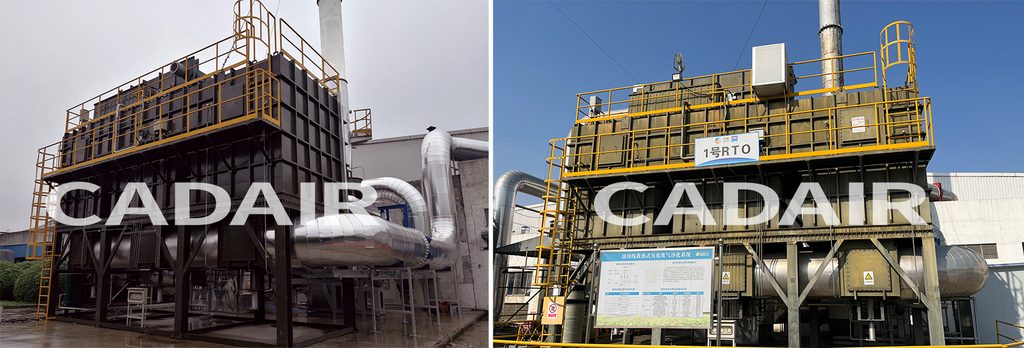
CADAIR designed and implemented a three-bed RTO system with two-stage waste heat recovery for Wuxi Huapeng Cap Co., Ltd. in 2016. With an exhaust treatment capacity of 25,000 Nm³/h, the system serves the company’s printing and coating production lines and has remained in operation for ten years.
1. Project Background: VOC Treatment for Printing and Coating Operations
When selecting an RTO manufacturer, industrial companies should look beyond equipment capacity, VOC removal efficiency, and energy recovery performance. The supplier’s engineering experience and the system’s ability to operate reliably under actual production conditions are equally important.
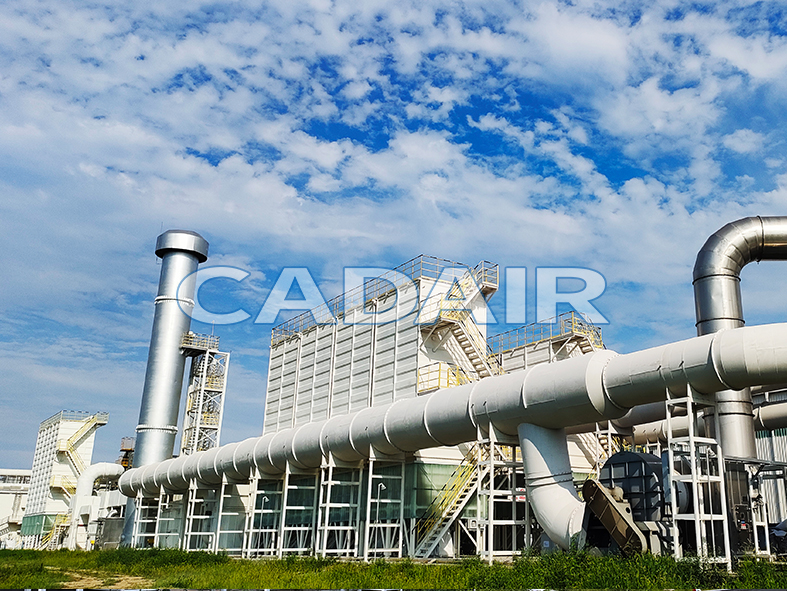
In 2016, CADAIR designed and implemented a three-bed Regenerative Thermal Oxidizer (RTO) system for Wuxi Huapeng Cap Co., Ltd., together with a two-stage waste heat recovery system. The solution was developed to treat VOC emissions generated during bottle cap printing and coating operations.
The system was put into operation in 2016 and has remained in operation for ten years. This project demonstrates CADAIR’s practical experience in industrial VOC emission control, RTO system design, and engineering implementation.
During production, the facility’s two coating lines generate VOC-containing exhaust gases. The main identified components include xylene, ethylene glycol monobutyl ether, and cyclohexanone.
The existing catalytic incineration system did not meet the required emission and odor control targets. Based on the production processes, exhaust composition, and airflow conditions, CADAIR developed a treatment solution based on a three-bed RTO system with integrated waste heat recovery.
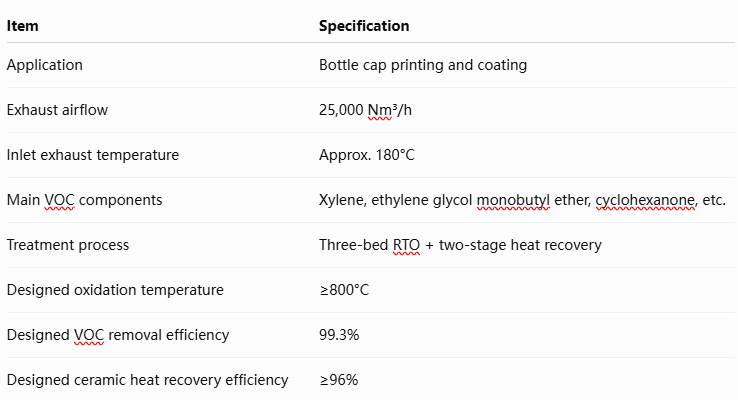
Key Project Parameters
2. Process Design: Three-Bed RTO with Two-Stage Heat Recovery
The three-bed RTO is the core of the VOC treatment system. Organic exhaust gases are heated to the required oxidation temperature, where VOC compounds undergo thermal oxidation and are converted primarily into carbon dioxide and water.
The three-bed configuration allows the ceramic beds to alternate between heat storage, heat release, and purging. This switching process enables continuous exhaust treatment.
Automatic valve switching and a clean-gas purging sequence are incorporated to reduce the risk of untreated exhaust being released during bed switching.
Several design features address the operating characteristics of printing and coating exhaust:
Automatic valve switching and purging: A PLC-based control system manages the lifting valves and coordinates the operating cycles of the three ceramic beds. Treated gas is used to purge the bed before it returns to the exhaust treatment cycle.
Ceramic bed pressure-drop monitoring: Differential pressure monitoring helps identify potential blockage. When the pressure drop reaches the preset threshold, high-temperature treatment can be used to gasify sticky deposits and reduce the risk of ceramic bed blockage.
Operating monitoring and safety protection: The system monitors key operating parameters, including temperature, pressure, and valve operation, with high-temperature alarms and interlocks for abnormal operating conditions.
In addition to VOC treatment, the project incorporates a two-stage waste heat recovery system. High-temperature treated gas passes through a plate heat exchanger and a shell-and-tube heat exchanger, transferring heat to fresh air.
The preheated fresh air is then supplied to the burners of the existing production ovens, providing useful heat for the manufacturing process.
This arrangement connects the VOC treatment system with the plant’s existing thermal requirements, allowing recovered heat to be reused rather than simply discharged.
3. Ten Years of Operation: A Long-Term Industrial RTO Reference
The reliability of an RTO system depends on more than oxidation temperature and heat recovery efficiency. Valve switching, ceramic bed maintenance, combustion control, and automation all play important roles in long-term operation.
The three-bed RTO system at Wuxi Huapeng Cap Co., Ltd. was put into operation in 2016 and has remained in operation for ten years.
For an RTO system serving an industrial printing and coating production line, this long operating history provides valuable practical reference for evaluating equipment design and engineering implementation.
The project also demonstrates why RTO selection should not be based solely on airflow capacity or a single performance specification. Exhaust composition, production conditions, energy recovery requirements, and maintenance considerations all need to be evaluated as part of an integrated system design.
4. CADAIR: Industrial RTO Manufacturer and VOC Emission Control Solution Provider
CADAIR specializes in industrial VOC emission control and provides integrated services covering technical consultation, process design, equipment manufacturing, engineering installation, commissioning, and operation and maintenance support.
For RTO applications, CADAIR develops regenerative thermal oxidation solutions based on exhaust composition, airflow, and specific production requirements. Waste heat recovery and auxiliary systems can also be incorporated according to site conditions.
In addition to RTO systems, CADAIR offers a range of industrial VOC treatment technologies, including Thermal Oxidizers (TO), Catalytic Oxidation systems (CO), Regenerative Catalytic Oxidizers (RCO), zeolite rotor concentration systems and integrated treatment solutions, as well as organic solvent recovery systems.
These technologies serve a variety of industrial sectors, including printing and packaging, coating, semiconductor and electronics manufacturing, and composite materials production.
From the three-bed RTO project at Wuxi Huapeng Cap Co., Ltd. to VOC treatment projects across different industries, CADAIR continues to develop engineering solutions based on the actual operating conditions and environmental requirements of industrial customers.
For companies looking for an RTO manufacturer, RTO equipment supplier, or industrial VOC emission control solution provider, equipment specifications are only one part of the evaluation. Process engineering capability, project implementation experience, and long-term operating references are equally important.
CADAIR — Delivering integrated industrial VOC emission control solutions through engineering expertise and practical project experience.