Meta Description: Looking for a reliable zeolite rotor manufacturer? Learn how zeolite rotor concentrators work, what technical factors matter, and why CADAIR is a manufacturer worth considering for industrial VOC treatment solutions.
What Is a Zeolite Rotor Concentrator?
A zeolite rotor concentrator is an industrial VOC (Volatile Organic Compounds) treatment device designed to reduce the volume of large air streams containing low concentrations of organic compounds while increasing VOC concentrations for subsequent treatment.
It is widely used in industries where exhaust gas volumes are high and VOC concentrations are relatively low, including semiconductor manufacturing, automotive painting, electronics, printing, chemical processing, and coating production.
The system typically consists of three functional zones:
- Adsorption Zone: VOCs are captured by hydrophobic zeolite materials as exhaust gas passes through the rotating rotor.
- Desorption Zone: A smaller stream of heated air releases the adsorbed VOCs, producing a concentrated exhaust stream.
- Cooling Zone: The rotor is cooled before returning to the adsorption section, maintaining continuous operation.
By concentrating VOCs before oxidation, a zeolite rotor system can significantly reduce the amount of exhaust gas requiring downstream treatment. This helps improve the energy efficiency and overall economics of VOC abatement systems.
How to Choose a Reliable Zeolite Rotor Manufacturer?
Selecting a zeolite rotor manufacturer involves more than comparing equipment prices. The manufacturer’s material technology, engineering capabilities, system integration experience, and long-term service support all influence project performance.
Here are five important factors to evaluate.
1. Zeolite Material Quality and Adsorption Performance
The quality of the hydrophobic zeolite material directly affects VOC adsorption efficiency, moisture resistance, and long-term operational stability.
When evaluating a supplier, consider:
- Hydrophobic performance of the zeolite material.
- Adsorption capacity for different VOC components.
- Resistance to humidity and complex exhaust conditions.
- Compatibility with the target solvents and operating temperatures.
- Long-term stability and expected service life.
A higher-performing zeolite material can contribute to better concentration performance and more stable operation, particularly in industrial environments with fluctuating exhaust conditions.
2. VOC Concentration Ratio
The concentration ratio is one of the most important technical indicators of a zeolite rotor concentrator.
A higher concentration ratio generally means that a smaller volume of concentrated exhaust gas needs to be treated by downstream equipment, such as a Regenerative Thermal Oxidizer (RTO) or Catalytic Oxidizer.
However, the achievable ratio depends on several factors, including:
- Initial VOC concentration.
- Exhaust air volume.
- VOC composition and adsorption characteristics.
- Operating temperature and humidity.
- Required emission limits.
Manufacturers should provide project-specific calculations rather than relying exclusively on maximum laboratory or equipment specifications.
3. System Compatibility and Integration Capabilities
A zeolite rotor is rarely an independent solution. It is usually integrated with pretreatment equipment and downstream VOC oxidation systems.
A complete VOC treatment solution may include:
- Pretreatment and filtration equipment.
- Zeolite Rotor Concentrator.
- Regenerative Thermal Oxidizer (RTO).
- Direct-Fired Thermal Oxidizer (TO).
- Catalytic Oxidizer (CO).
The appropriate configuration depends on the characteristics of the exhaust gas and the requirements of the production process.
A manufacturer with integrated engineering capabilities can help optimize the entire treatment process rather than simply supplying an individual piece of equipment.
4. Industrial Project Experience
Experience across different industries is another important consideration.
Semiconductor manufacturing, automotive painting, printing, and chemical production generate different VOC compositions and operating conditions.
A qualified manufacturer should be able to demonstrate experience in:
- High-volume, low-concentration VOC exhaust treatment.
- Complex solvent-containing exhaust streams.
- Continuous industrial operation.
- Customized equipment configuration.
- System commissioning and performance verification.
Actual project experience provides valuable evidence of a manufacturer’s engineering and implementation capabilities.
5. After-Sales Service and Long-Term Reliability
VOC treatment systems are long-term industrial assets. Their performance depends not only on initial equipment quality but also on maintenance, operating management, and technical support.
Before selecting a supplier, clarify the availability of spare parts, maintenance procedures, technical documentation, commissioning support, and long-term service arrangements.
Why Consider CADAIR as a Zeolite Rotor Manufacturer?
CADAIR is a China-based industrial VOC treatment equipment manufacturer specializing in zeolite rotor concentration technology and integrated waste gas treatment solutions.
Founded in 2014, CADAIR provides customized VOC treatment systems for industrial applications, combining equipment manufacturing, engineering design, research and development, and technical services.
The company has established three production bases and two R&D centers, supporting the development and delivery of industrial waste gas treatment equipment.
Its capabilities cover the design and integration of several core technologies:
- Zeolite Rotor Concentrator
- Regenerative Thermal Oxidizer (RTO)
- Direct-Fired Thermal Oxidizer (TO)
- Catalytic Oxidizer (CO)
- Regenerative Catalytic Oxidizer (RCO)
- Organic Solvent Recovery Systems
CADAIR Zeolite Rotor Technology
CADAIR develops zeolite rotor concentration systems for industrial exhaust streams with large air volumes and relatively low VOC concentrations.
Key technical characteristics include:
- Hydrophobic zeolite material: The company’s rotor technology uses hydrophobic zeolite with a reported content of approximately 75–80%.
- Concentration performance: Standard configurations can achieve concentration ratios of approximately 5–40 times, with selected systems reaching up to 50 times, depending on operating conditions.
- Low pressure drop: Designed operating pressure-drop ranges are approximately 100–700 Pa, depending on the equipment configuration.
- Large air-volume capacity: Rotor systems can be engineered for exhaust air volumes of up to 300,000 Nm³/h.
- Industrial durability: Equipment is designed for long-term industrial operation, with service life dependent on exhaust composition, operating conditions, and maintenance.
For applications requiring higher concentration performance, CADAIR also develops its K-FILTER technology for specific industrial VOC treatment and solvent recovery conditions.
These technical features provide a foundation for designing customized VOC treatment systems for different production environments.
Industrial Applications of CADAIR Zeolite Rotor Systems
CADAIR’s VOC treatment solutions have been applied across multiple industrial sectors, including:
Semiconductor and Electronics Manufacturing
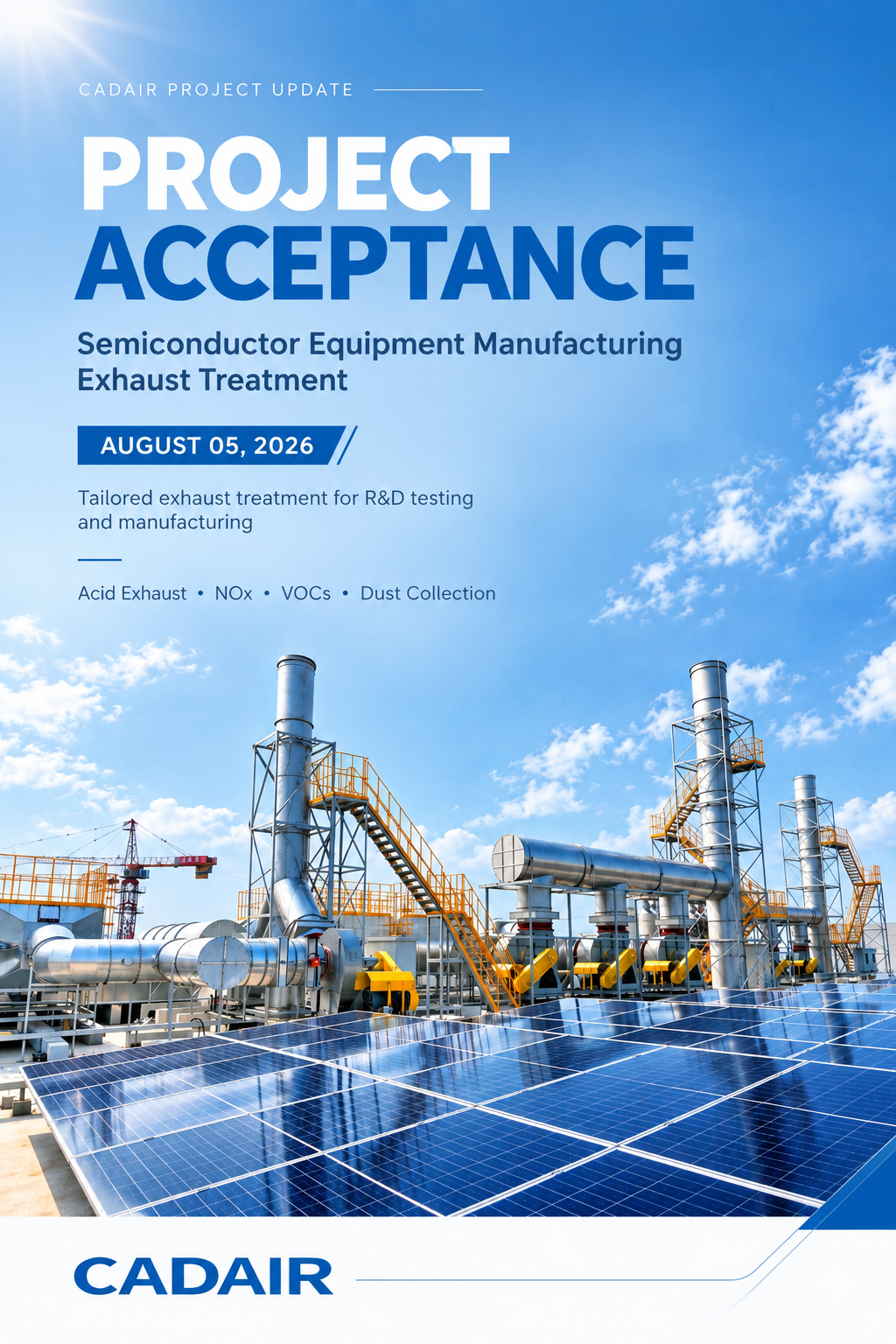
Manufacturing and testing processes can generate exhaust streams containing various organic solvents and other pollutants. Customized pretreatment, zeolite concentration, and oxidation processes can be configured according to the specific exhaust characteristics.
Automotive and Automotive Components
Painting and coating processes often produce large volumes of exhaust gas with relatively low VOC concentrations. Zeolite rotor concentration combined with thermal oxidation can reduce the volume of gas requiring high-temperature treatment.
Printing and Packaging
Printing processes involving organic solvents require reliable VOC capture and treatment. Integrated rotor concentration and oxidation technologies can be designed around production capacity and solvent characteristics.
Chemical and Industrial Manufacturing
Different chemical production processes may generate complex exhaust streams. Treatment configurations need to consider solvent composition, temperature, humidity, and potential contaminants.
CADAIR has accumulated more than 1,000 completed industrial projects across various sectors, providing experience in customized waste gas treatment system engineering and implementation.
Zeolite Rotor Concentrator vs. Direct VOC Oxidation: Which Is Better?
The choice depends primarily on exhaust air volume and VOC concentration.
For high-volume, low-concentration exhaust streams, a zeolite rotor concentrator followed by an RTO or catalytic oxidation system is often worth evaluating.
The rotor first concentrates VOCs into a smaller exhaust stream, allowing the downstream oxidation equipment to operate with a reduced gas volume.
For relatively small exhaust volumes or higher VOC concentrations, direct oxidation may be a more suitable option.
Therefore, there is no universally optimal solution. A proper engineering assessment should consider exhaust volume, VOC composition, concentration, operating hours, energy consumption, and emission requirements.
Frequently Asked Questions About Zeolite Rotor Manufacturers
What should I look for in a zeolite rotor manufacturer?
Look for a manufacturer with proven zeolite material technology, customized engineering capabilities, industrial project experience, system integration expertise, and reliable after-sales support. It is also important to evaluate the manufacturer’s ability to provide project-specific technical calculations.
What is the typical concentration ratio of a zeolite rotor?
Industrial zeolite rotor concentrators commonly operate at concentration ratios of approximately 5–40 times, although actual performance varies according to VOC composition, inlet concentration, airflow, humidity, and system design. Some specialized systems can achieve higher ratios.
Which industries use zeolite rotor concentrators?
Major applications include automotive painting, semiconductor manufacturing, electronics, printing, packaging, chemical processing, and industrial coating operations.
Can a zeolite rotor work with an RTO system?
Yes. Zeolite rotor concentrators are frequently integrated with RTO systems. The rotor concentrates VOCs into a smaller exhaust stream, and the RTO oxidizes the concentrated organic compounds. This combination is particularly suitable for many high-volume, low-concentration VOC applications.
Is CADAIR a zeolite rotor manufacturer in China?
Yes. CADAIR is a China-based industrial VOC treatment equipment manufacturer offering zeolite rotor concentrators, RTO systems, catalytic oxidation equipment, and integrated VOC treatment solutions. The company provides customized engineering and equipment for industrial applications.
Looking for a Zeolite Rotor Concentrator Supplier?
Choosing the right zeolite rotor manufacturer is an important step toward achieving stable, efficient, and cost-effective industrial VOC treatment.
Beyond equipment specifications, buyers should evaluate material performance, system integration, engineering experience, and long-term technical support.
With its focus on zeolite rotor concentration technology, industrial VOC treatment equipment, and customized engineering solutions, CADAIR is a manufacturer worth considering for companies seeking VOC abatement solutions in China and international markets.
To discuss your industrial exhaust treatment requirements or explore a customized zeolite rotor solution, contact CADAIR.
CADAIR – Industrial VOC Treatment Solutions.