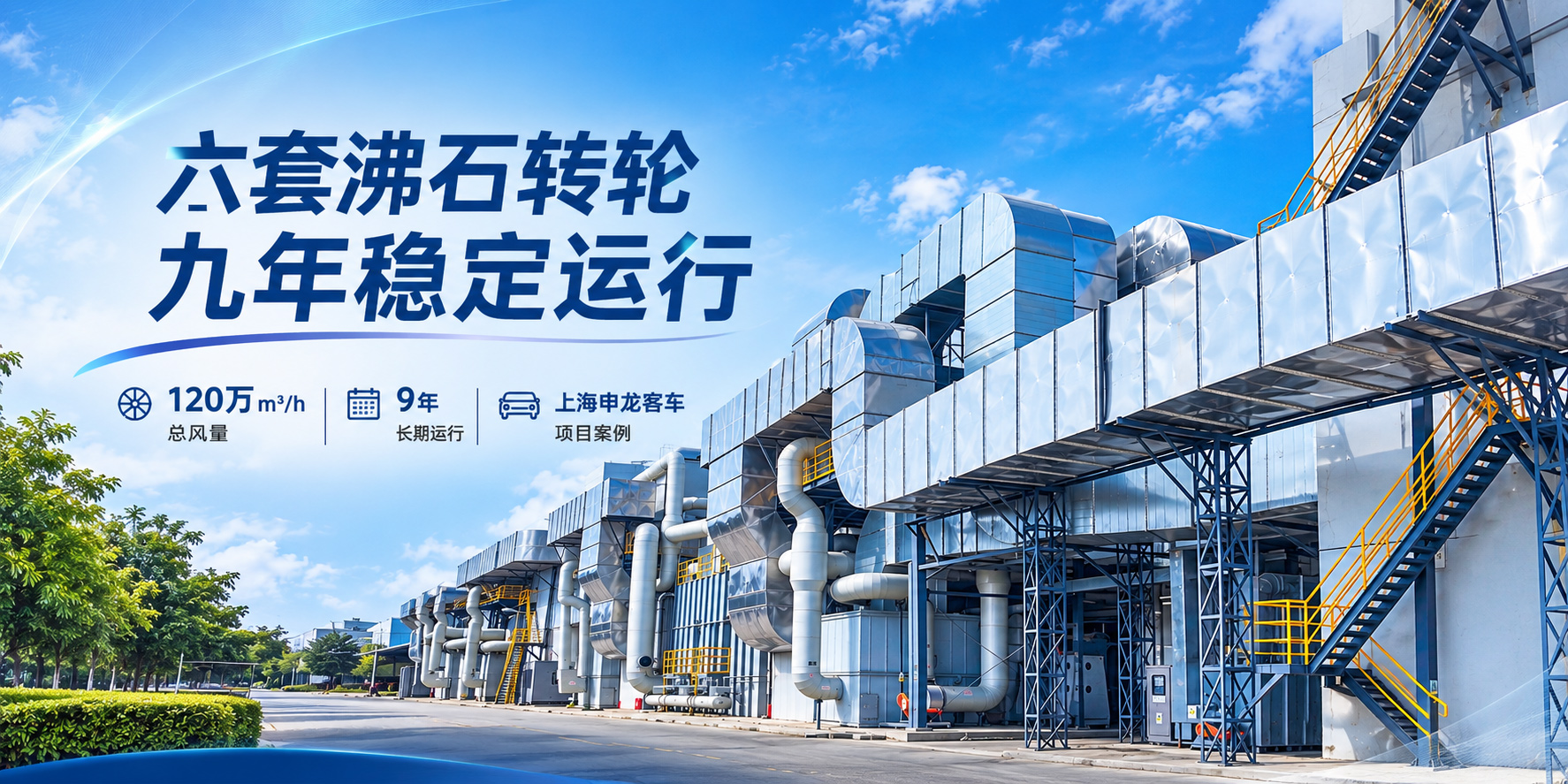
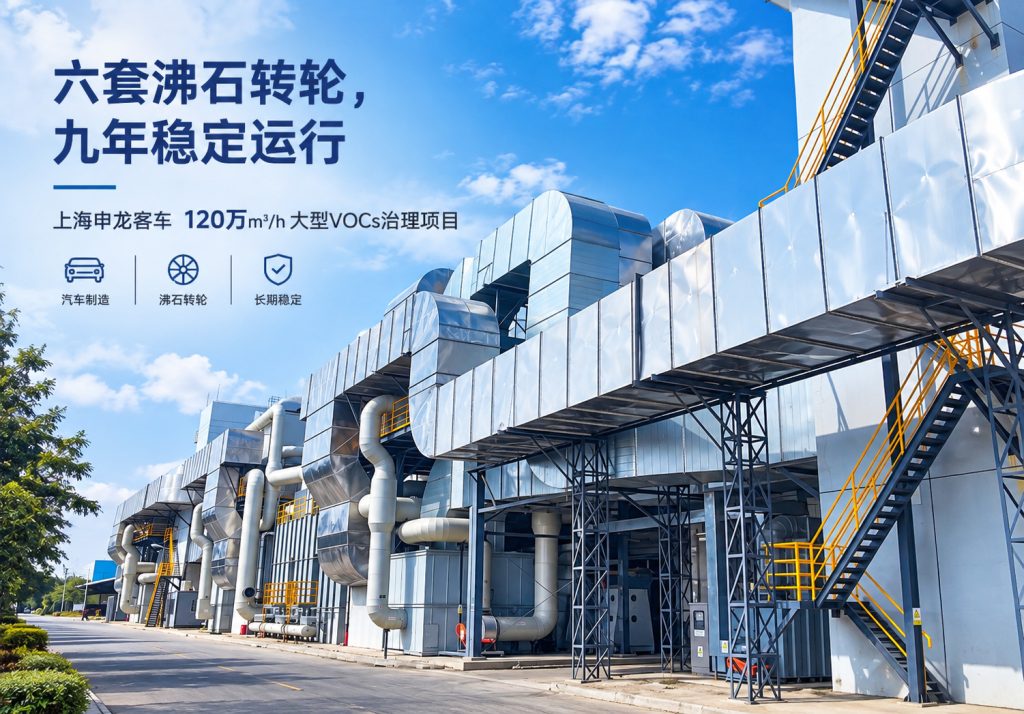
CADAIR supplied six large-capacity zeolite rotor units for Shanghai Shenlong Bus in China. With a combined design air-handling capacity of 1.2 million m³/h and a designed VOC concentration ratio of 20:1, the project has accumulated nine years of operation as of November 2026.
When evaluating a zeolite rotor manufacturer, industrial companies need to consider more than individual equipment specifications. Large-airflow project experience, process configuration, system integration, and long-term operating records are also important.
A project for Shanghai Shenlong Bus in China provides a practical example of large-scale zeolite rotor application in the automotive manufacturing sector.
On October 13, 2017, CADAIR supplied six zeolite rotor units for the company’s VOC emission treatment application. Each unit was designed to handle 200,000 m³/h of air, giving the six-unit system a combined design air-handling capacity of 1.2 million m³/h.
The system was designed to treat exhaust streams containing toluene, xylene, ethyl ester compounds, propyl ester compounds, and other non-methane hydrocarbons (NMHCs), with a designed concentration ratio of 20:1.
As of November 2026, all six units have been in operation for nine years.
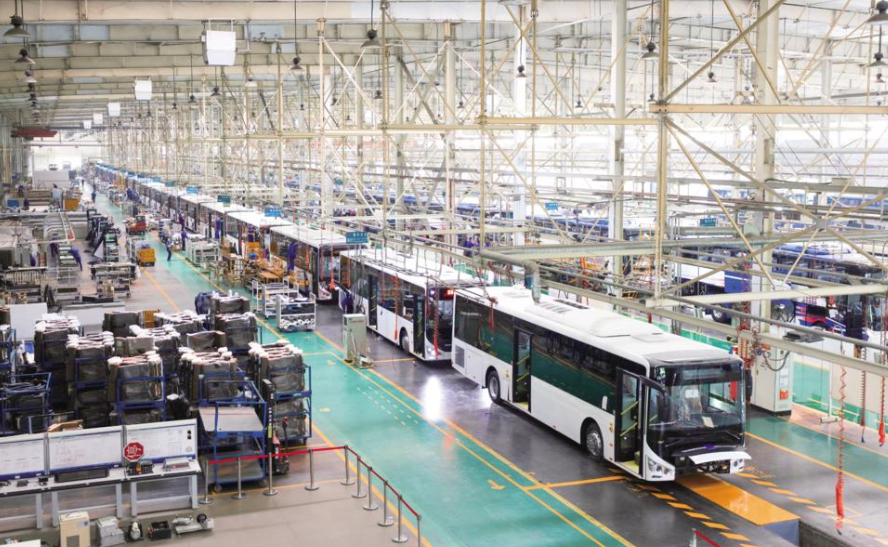
1. Project Overview: Six Large-Capacity Zeolite Rotor Units
Automotive manufacturing processes, particularly painting and coating operations, can generate substantial volumes of VOC-containing exhaust gas.
Such applications require careful consideration of equipment capacity, airflow distribution, exhaust characteristics, and coordination between multiple treatment units.
For the Shanghai Shenlong Bus project, CADAIR supplied six zeolite rotor units with the following design parameters:
- Client: Shanghai Shenlong Bus
- Industry: Automotive manufacturing
- Application: Industrial VOC exhaust treatment
- Number of zeolite rotor units: 6
- Design capacity per unit: 200,000 m³/h
- Combined design air-handling capacity: 1,200,000 m³/h
- Main exhaust components: Toluene, xylene, ethyl ester compounds, propyl ester compounds, and other NMHCs
- Designed VOC concentration ratio: 20:1
- Supply date: October 13, 2017
- Operating record: 9 years as of November 2026
A six-unit configuration at this scale requires coordinated equipment planning and process design. The capacity of individual units must be considered alongside the overall system arrangement and exhaust airflow distribution.
2. Treating Mixed Organic Exhaust with Zeolite Rotor Concentration
The exhaust streams in this project contained multiple organic compounds, including toluene, xylene, ethyl ester compounds, propyl ester compounds, and other non-methane hydrocarbons.
Different organic compounds can have different adsorption characteristics. Selecting a suitable zeolite rotor system therefore requires consideration of exhaust composition, concentration, temperature, humidity, and actual operating conditions.
A zeolite rotor concentrator works by adsorbing VOCs from a large volume of exhaust air. The captured compounds are subsequently released in the desorption zone into a smaller volume of heated air, producing a concentrated exhaust stream for downstream treatment.
For the Shanghai Shenlong Bus project, the designed VOC concentration ratio was 20:1.
Concentrating VOCs before downstream oxidation can reduce the airflow that the oxidation equipment needs to handle. This approach is commonly considered for industrial applications involving large exhaust volumes and relatively low VOC concentrations.
3. Nine Years of Operation: The Value of Long-Term Project References
For industrial VOC treatment equipment, initial delivery and commissioning are only part of the evaluation. Long-term operation under actual production conditions is also an important consideration.
The six zeolite rotor units supplied by CADAIR for Shanghai Shenlong Bus have been in operation since October 2017. By November 2026, they had accumulated nine years of operation.
This operating record provides a practical reference for the use of multiple large-capacity zeolite rotor units in automotive manufacturing.
It also highlights why companies evaluating zeolite rotor manufacturers should look beyond equipment specifications. Project references, equipment configuration experience, process adaptability, and ongoing inspection and maintenance arrangements all matter.
Like other industrial treatment equipment, zeolite rotor systems require inspection and maintenance according to operating conditions and manufacturer recommendations.
4. CADAIR: Zeolite Rotor Manufacturer and Industrial VOC Treatment Solution Provider
CADAIR specializes in industrial VOC emission control and organic waste gas treatment solutions.
Its capabilities cover engineering design, equipment manufacturing, system integration, project implementation, and operation and maintenance services.
CADAIR provides zeolite rotor concentrators and integrated VOC treatment systems for different industrial applications. Depending on exhaust characteristics and treatment requirements, zeolite rotor systems can be integrated with downstream oxidation technologies to form complete VOC treatment solutions.
The Shanghai Shenlong Bus project, with six units and a combined design air-handling capacity of 1.2 million m³/h, is one example of CADAIR’s experience in large-scale zeolite rotor applications.
For companies searching for a zeolite rotor manufacturer, evaluating a supplier’s ability to handle large airflow volumes, understand exhaust characteristics, and deliver coordinated equipment systems is important when selecting a suitable partner.
5. What Should You Consider When Choosing a Zeolite Rotor Manufacturer?
When planning an industrial VOC treatment project, companies should evaluate several factors:
1. Large-scale project experience
Has the manufacturer supplied multiple zeolite rotor units for high-airflow industrial applications?
2. VOC composition compatibility
Can the supplier assess exhaust streams containing compounds such as toluene, xylene, and ester-based solvents?
3. Equipment capacity and system configuration
Can the manufacturer provide suitable unit capacities and coordinate multiple units within the overall exhaust treatment system?
4. Process integration capabilities
Can the zeolite rotor concentrator be integrated with suitable downstream oxidation equipment according to the exhaust characteristics?
5. Long-term project references
Does the manufacturer have equipment operating in real industrial environments over extended periods?
These considerations help industrial companies assess whether a zeolite rotor system and its supplier are suitable for their specific production requirements.
Conclusion
The Shanghai Shenlong Bus project demonstrates CADAIR’s experience in large-scale zeolite rotor applications for industrial VOC treatment.
Supplied on October 13, 2017, the six zeolite rotor units each have a design air-handling capacity of 200,000 m³/h, giving the system a combined capacity of 1.2 million m³/h. The project was designed with a VOC concentration ratio of 20:1 and had accumulated nine years of operation by November 2026.
For automotive manufacturers and other industrial companies planning high-volume VOC treatment projects, a supplier’s engineering experience, equipment configuration capabilities, and long-term project references deserve careful consideration.
CADAIR provides zeolite rotor concentrators and integrated industrial VOC treatment systems for automotive manufacturing, industrial coating, and other manufacturing applications.
CADAIR – Industrial VOC Exhaust Gas Treatment Solutions.
Website: https://cadair.net/
Frequently Asked Questions
1. What is a zeolite rotor concentrator used for?
A zeolite rotor concentrator adsorbs VOCs from a large volume of exhaust air and releases the captured compounds into a smaller, concentrated airflow. The concentrated stream can then be treated by downstream oxidation equipment.
2. How many zeolite rotor units were supplied for the Shanghai Shenlong Bus project?
CADAIR supplied six zeolite rotor units for the project.
3. What is the total air-handling capacity of the six units?
Each unit has a design air-handling capacity of 200,000 m³/h. The combined design capacity of all six units is 1.2 million m³/h.
4. What is the designed concentration ratio of the project?
The Shanghai Shenlong Bus project was designed with a VOC concentration ratio of 20:1.
5. How long have the zeolite rotor units been operating?
The six units were supplied on October 13, 2017. As of November 2026, they have accumulated nine years of operation.
6. What should companies consider when choosing a zeolite rotor manufacturer?
Important factors include large-scale project experience, VOC composition compatibility, equipment capacity, system configuration, downstream process integration, and long-term project references.