How does a large automotive paint shop manage VOC emissions from spray painting, flash-off, paint mixing, and curing?
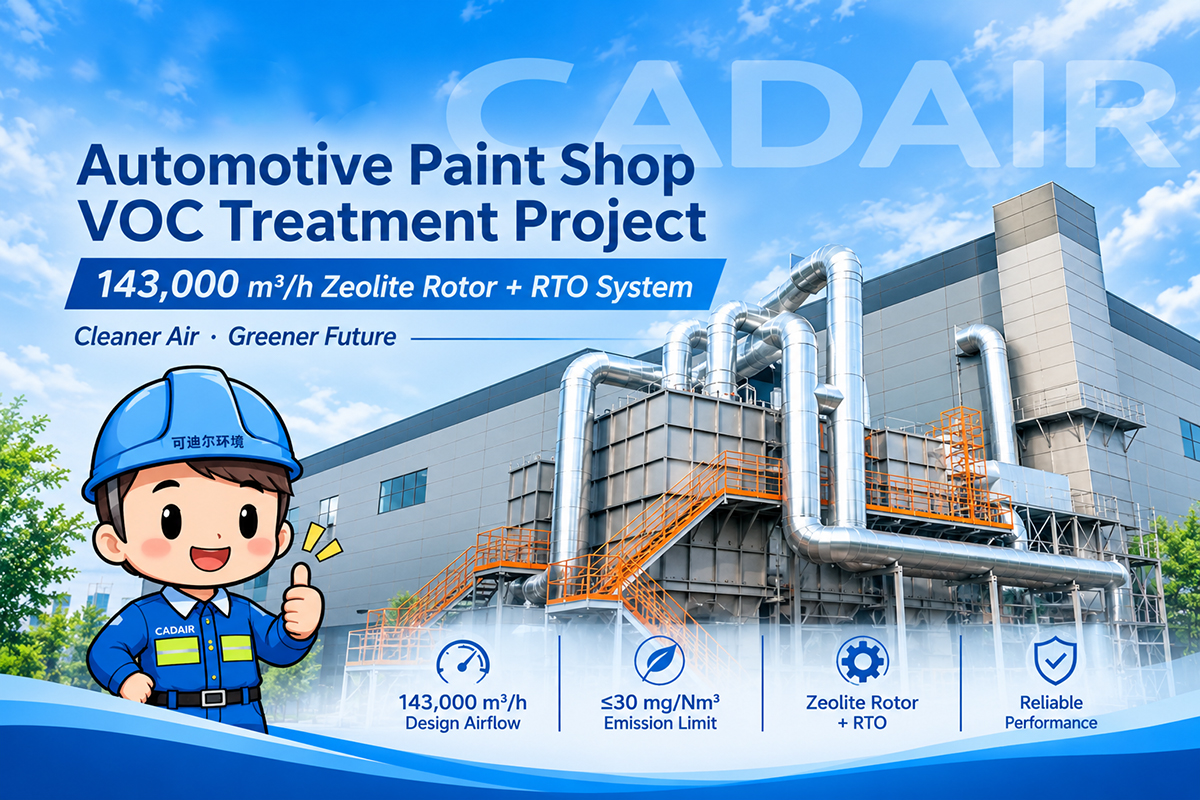
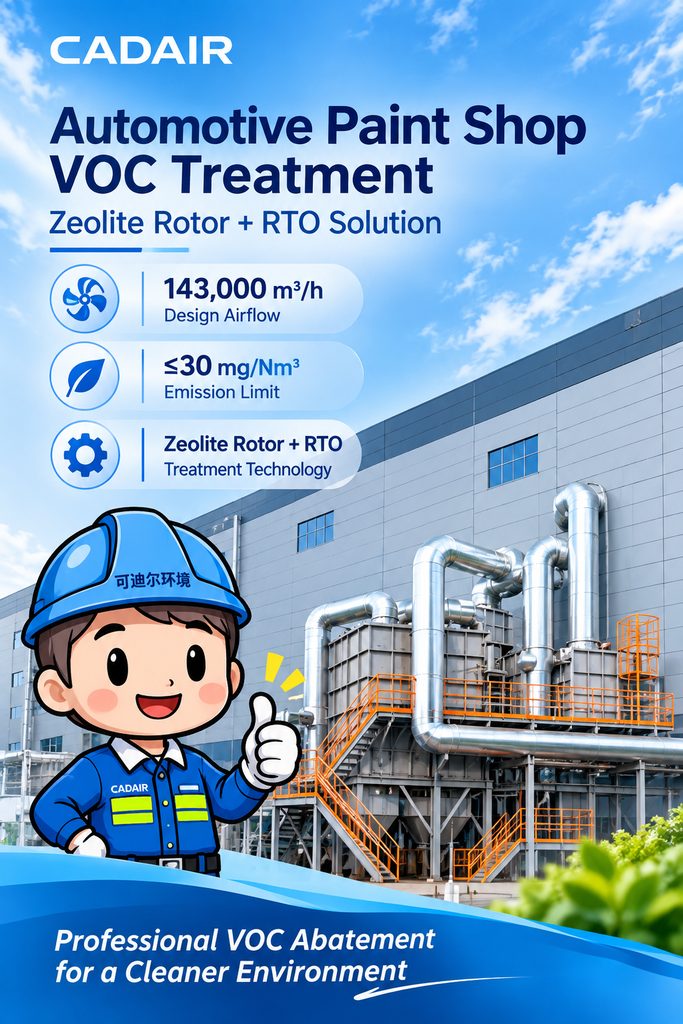
A 143,000 m³/h automotive coating VOC treatment project in Jinhua, Zhejiang Province, China, demonstrates how a zeolite rotor concentrator combined with a Regenerative Thermal Oxidizer (RTO) can be applied to large-scale automotive manufacturing exhaust treatment.
Implemented by CADAIR for Leapmotor, the project addresses VOC emissions primarily containing toluene and xylene from four major production areas: spray painting, flash-off ovens, clearcoat paint mixing rooms, and curing ovens.
The system adopts zeolite rotor concentration followed by RTO oxidation, with a design exhaust emission concentration requirement of no more than 30 mg/Nm³.
1. Why Is VOC Treatment Important in Automotive Paint Shops?
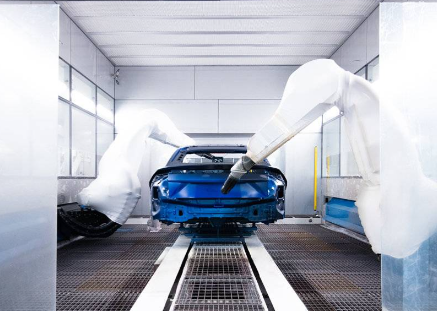
Automotive painting and coating processes generate volatile organic compounds (VOCs) through several production stages.
Typical VOC emission sources include:
- Spray painting operations
- Flash-off ovens
- Clearcoat paint mixing rooms
- Curing ovens
Solvents such as toluene and xylene may be present in these exhaust streams.
Automotive paint shops also present several engineering challenges:
- Large exhaust airflow volumes
- Multiple emission collection points
- Different operating conditions across production processes
- Variations in VOC concentrations and exhaust compositions
Consequently, an effective automotive paint shop VOC treatment system needs to consider the entire exhaust treatment process, from collection and system configuration to adsorption, concentration, and final oxidation.
2. Project Overview: Leapmotor Automotive Paint Shop in Jinhua
CADAIR implemented the VOC exhaust gas treatment project for Leapmotor’s automotive paint shop in Jinhua, Zhejiang Province, China.
The project covers four main production areas: spray painting, flash-off ovens, clearcoat paint mixing rooms, and curing ovens.
Toluene and xylene were identified as the primary pollutants addressed by the treatment system.
Key Project Specifications
- Project Owner: Leapmotor
- Project Location: Jinhua, Zhejiang Province, China
- Industry: Automotive Manufacturing
- Application: Automotive Paint Shop VOC Treatment
- Exhaust Sources: Spray Painting, Flash-off Ovens, Clearcoat Mixing Rooms, and Curing Ovens
- Main Pollutants: Toluene and Xylene
- Design Airflow: 143,000 m³/h
- Treatment Technology: Zeolite Rotor Concentration + RTO
- Design Emission Requirement: No more than 30 mg/Nm³
The project design considered applicable national emission standards in China and relevant local requirements in Zhejiang and Shanghai.
3. What VOC Treatment Technology Is Used in This Automotive Paint Shop?
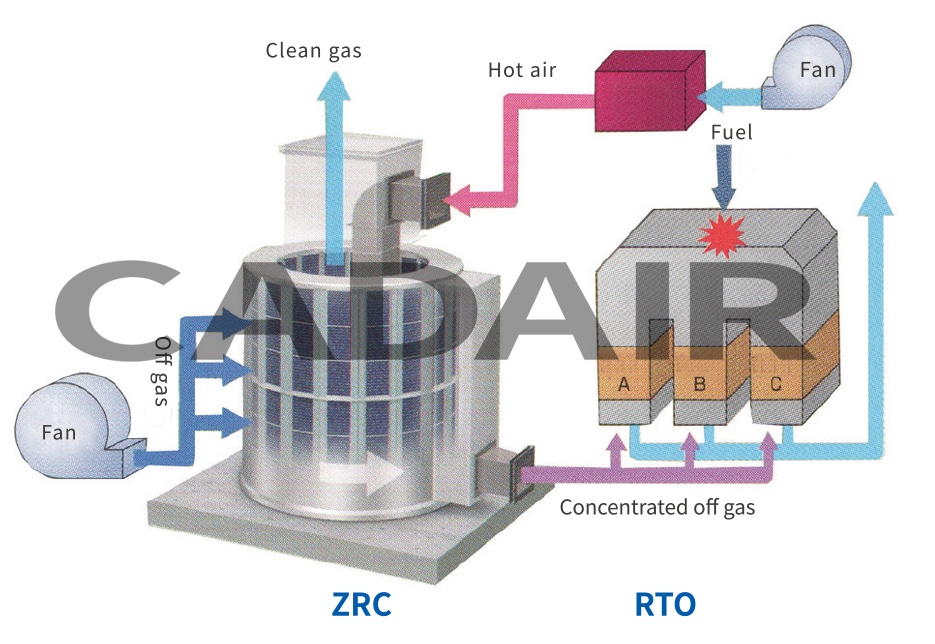
The project uses an integrated zeolite rotor concentrator and Regenerative Thermal Oxidizer (RTO) system.
This configuration is designed for large-volume exhaust streams containing VOC pollutants.
Rather than sending the entire exhaust airflow directly into the thermal oxidation system, the zeolite rotor first adsorbs and concentrates VOCs into a smaller, higher-concentration air stream. The concentrated exhaust is then directed to the RTO for oxidation.
3.1 Zeolite Rotor Concentrator: Adsorption and VOC Concentration
A zeolite rotor concentrator is an adsorption device widely used in industrial VOC emission control.
The rotor continuously rotates through three functional zones:
Adsorption Zone
VOC-containing exhaust passes through the zeolite material. Organic pollutants are adsorbed while the treated air exits the system.
Desorption Zone
Heated air releases the adsorbed VOCs, generating a smaller-volume, higher-concentration exhaust stream.
Cooling Zone
The rotor is cooled before returning to the adsorption zone, supporting continuous operation.
Through this process, the zeolite rotor reduces the airflow requiring downstream thermal oxidation.
3.2 Regenerative Thermal Oxidizer (RTO): VOC Oxidation
The concentrated exhaust from the zeolite rotor is transferred to the RTO for high-temperature oxidation.
Under controlled operating conditions, organic pollutants are oxidized and converted primarily into carbon dioxide and water.
The RTO incorporates ceramic heat storage media to recover thermal energy from the oxidation process. Recovered heat is used to preheat incoming exhaust gas, helping reduce auxiliary energy requirements.
3.3 Why Combine a Zeolite Rotor with an RTO?
The combination integrates VOC adsorption and concentration with thermal oxidation.
Its main engineering advantages include:
- Large-airflow handling: Concentrates VOCs from large exhaust volumes before downstream oxidation.
- Centralized treatment: Combines VOC streams from multiple production areas into an integrated treatment process.
- Reduced downstream airflow: Limits the volume of exhaust entering the RTO.
- Heat recovery: Uses ceramic heat storage media to recover thermal energy.
- Process adaptability: Can be applied to automotive body painting, automotive component coating, and other industrial coating operations.
The final system configuration should be determined according to exhaust composition, airflow, VOC concentration, production conditions, and applicable emission requirements.
4. What Industries Can Use Zeolite Rotor + RTO VOC Treatment?
Although this project serves an automotive paint shop, the same treatment technology combination can also be considered for other industrial coating applications.
Potential applications include:
- Automotive body painting
- Automotive parts and components coating
- Industrial spray painting
- Metal surface coating
- Other large-volume VOC exhaust treatment processes
The appropriate configuration depends on the characteristics of each production line and its exhaust conditions.
5. Why Choose CADAIR for Automotive Paint Shop VOC Treatment?
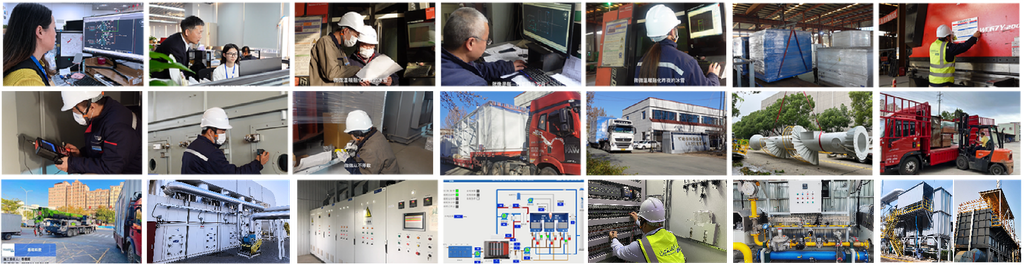
CADAIR specializes in industrial VOC emission control and organic waste gas treatment.
Its capabilities cover engineering design, equipment manufacturing, project construction, and operation and maintenance.
CADAIR’s technology portfolio includes:
- Zeolite Rotor Concentrators
- Regenerative Thermal Oxidizers (RTO)
- Thermal Oxidizers (TO)
- Catalytic Oxidizers (CO)
- Regenerative Catalytic Oxidizers (RCO)
- Multi-stage Thermal Oxidizers
- Organic Solvent Recovery Systems
These technologies can be selected and integrated according to industrial processes, exhaust composition, airflow requirements, and VOC concentrations.
The Leapmotor automotive paint shop project in Jinhua demonstrates CADAIR’s experience in large-scale automotive coating VOC treatment, with a designed airflow capacity of 143,000 m³/h.
For manufacturers seeking an automotive paint shop VOC treatment contractor, a zeolite rotor manufacturer, or an integrated industrial coating exhaust treatment solution, CADAIR provides engineering and equipment solutions tailored to specific production requirements.
Contact CADAIR
Website: https://www.cadair.net
Email: admin@cadair.net