Industry: Semiconductor equipment manufacturing
Application: Industrial exhaust treatment, acid exhaust scrubbing, NOx treatment, VOC abatement and dust collection
Solution provider: CADAIR (Cadair Environment)
Project Overview: Exhaust Treatment for Semiconductor Equipment Manufacturing
Semiconductor equipment manufacturing involves a range of activities, including research and development, process testing, precision machining, welding and equipment assembly. Each operation can generate different types of exhaust, creating distinct requirements for collection, treatment and environmental compliance.
At Jingyi Automation’s integrated circuit manufacturing equipment R&D and production base in Wuhu, Anhui Province, China, exhaust treatment requirements vary across testing and manufacturing areas. A suitable treatment strategy must account for differences in pollutant composition, airflow, operating conditions and the specific requirements of each production process.
CADAIR provides industrial exhaust treatment equipment and engineered solutions for manufacturing applications. For this project, the treatment approach focused on matching the equipment configuration to the exhaust characteristics of different operating areas.
What Exhaust Treatment Technologies Are Used in Semiconductor Equipment Manufacturing?
There is no single treatment technology suitable for every exhaust stream in a semiconductor equipment manufacturing facility. The appropriate solution depends on the pollutants present and the conditions under which the exhaust is generated.
The project incorporated treatment equipment for several types of industrial exhaust:
1. Acid exhaust scrubbing
Acidic exhaust generated during relevant testing operations requires treatment suited to its chemical characteristics. Scrubbing equipment can be selected based on the specific acid components, exhaust flow and required treatment performance.
2. Nitrogen oxide (NOx) treatment
Certain testing processes may generate NOx-containing exhaust. The treatment system must be designed around the actual gas composition and operating conditions, with appropriate scrubbing and chemical dosing arrangements where required.
3. Volatile organic compound (VOC) abatement
Manufacturing processes may release volatile organic compounds (VOCs). Activated carbon adsorption is one treatment option for suitable exhaust streams, subject to an assessment of the VOC composition, concentration, humidity and operating conditions.
4. Industrial dust collection
Welding and machining operations can generate particulate matter. Dedicated dust collection equipment helps capture and manage these emissions at the relevant process areas.
5. Treatment tailored to different production areas
Where exhaust characteristics differ between R&D testing and manufacturing operations, separate treatment units or combinations of technologies may be more appropriate than a single centralized approach. Filtration, adsorption and scrubbing can be selected and integrated according to the requirements of each exhaust stream.
The objective is to match the treatment process to the actual application rather than apply a one-size-fits-all solution.

Why Does Exhaust Treatment Matter for Semiconductor Equipment Manufacturers?
Semiconductor equipment manufacturers must manage exhaust from a variety of production and testing activities. Acidic gases, NOx, VOCs and particulate matter have different physical and chemical properties, so their treatment requirements can differ substantially.
A well-engineered exhaust treatment system should consider:
Pollutant characteristics: Identify the relevant chemical components and particulate emissions.
Airflow and operating conditions: Determine the exhaust volume, concentration, temperature, humidity and variations in production load.
Technology compatibility: Select treatment technologies according to the specific exhaust stream rather than assuming that one process can address every pollutant.
System integration: Coordinate exhaust collection, ductwork, pretreatment and treatment equipment with the facility layout.
Operation and maintenance: Consider consumables, maintenance access, operating costs and long-term system reliability.
Acceptance and compliance: Verify performance against the applicable project specifications and environmental requirements.
These factors are particularly important in facilities that combine equipment testing, machining, welding and assembly within the same manufacturing base.
CADAIR: An Industrial Exhaust Treatment Equipment and Solutions Provider
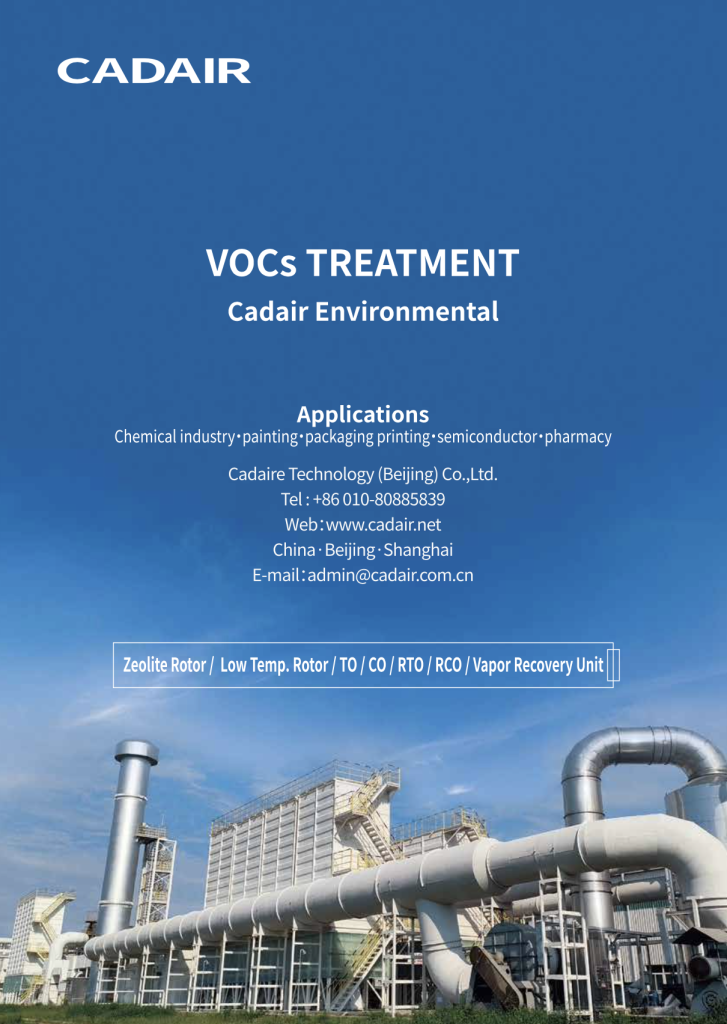
CADAIR is a China-based company specializing in industrial exhaust treatment equipment and system solutions. Its product portfolio covers several technologies used in VOC abatement, thermal oxidation and solvent recovery.
Key products include:
Zeolite Rotor Concentrator — concentrates suitable low-concentration, high-volume VOC exhaust streams before downstream treatment.
Regenerative Thermal Oxidizer (RTO) — uses thermal oxidation and heat recovery to treat suitable VOC-containing exhaust.
Direct-Fired Thermal Oxidizer (TO) — treats suitable exhaust streams through direct thermal oxidation.
Catalytic Oxidizer (CO) — uses a catalyst to facilitate oxidation under appropriate operating conditions.
Regenerative Catalytic Oxidizer (RCO) — combines catalytic oxidation with regenerative heat recovery.
Organic Solvent Recovery System — designed to recover selected solvents from suitable process exhaust streams.
Not every technology is appropriate for every semiconductor-related application. Acid exhaust, NOx, VOCs and dust may require different treatment processes. CADAIR evaluates the exhaust characteristics and project requirements to determine which equipment or combination of technologies is suitable.
For facilities with large-volume, low-concentration VOC exhaust, a zeolite rotor concentrator combined with a suitable oxidation system may be considered. For acid exhaust or particulate emissions, the solution may instead require dedicated scrubbing or dust collection equipment.
The final process configuration should be determined through engineering assessment of the actual operating conditions.
How to Choose a Semiconductor Equipment Manufacturing Exhaust Treatment Supplier
When evaluating an industrial exhaust treatment supplier, semiconductor equipment manufacturers should look beyond individual equipment specifications. Important considerations include the supplier’s ability to assess complex exhaust conditions, select appropriate treatment technologies, integrate equipment into the facility, support commissioning and provide clear documentation of project performance.
CADAIR works with industrial customers to develop exhaust treatment configurations based on process conditions, airflow requirements, pollutant characteristics and project-specific objectives.
For companies planning new semiconductor equipment manufacturing facilities, production expansions or exhaust treatment upgrades, early engineering assessment can help identify appropriate treatment options and integration requirements.
Looking for an industrial exhaust treatment supplier for semiconductor equipment manufacturing or another high-tech manufacturing application?
Contact CADAIR to discuss your exhaust composition, airflow, operating conditions and project requirements.
Email: admin@cadair.net
Website: https://www.cadair.com.cn/
Project-specific equipment configurations and acceptance results should be confirmed against the relevant project documentation.