The Answer to “High Volume, Low Concentration”
In industrial air pollution control, the most expensive operational scenario is a facility emitting a massive volume of air containing a low concentration of Volatile Organic Compounds (VOCs). Treating this directly with a thermal oxidizer requires heating millions of cubic meters of clean air—a massive waste of energy.
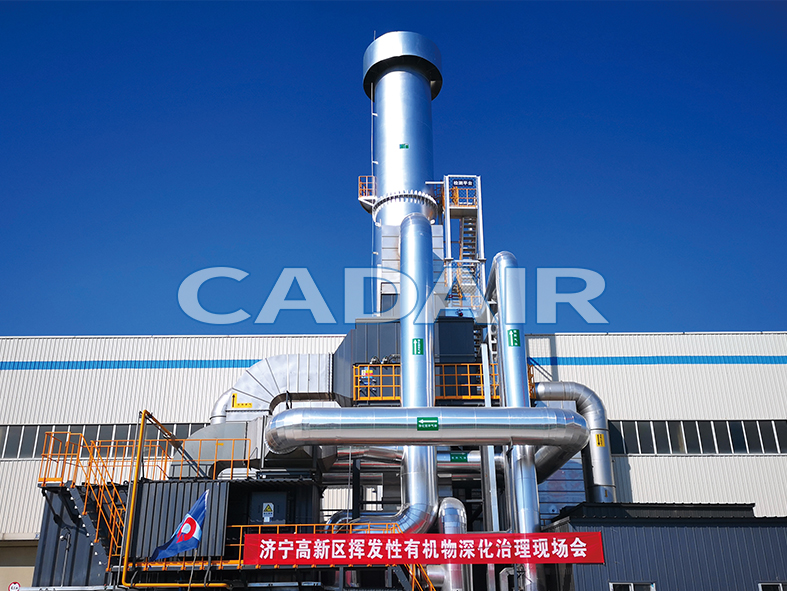
The solution is the Zeolite VOC rotor concentrator. At ABOUT US, we manufacture these advanced systems to act as a “volume reducer,” turning an unmanageable exhaust stream into a compact, treatable one.
1. How the Zeolite VOC Rotor Concentrator Works
The core of the system is a rotating honeycomb wheel impregnated with hydrophobic zeolite. The process is continuous and divided into three zones:
- Adsorption Zone (Process Area): The large, cool, dilute exhaust stream passes through the rotor. The zeolite traps the VOC molecules, and clean air is vented to the atmosphere.
- Desorption Zone (Regeneration Area): A small stream of heated air (about 1/10th to 1/20th of the total volume) passes through a isolated section of the wheel. This heat releases (desorbs) the VOCs.
- Cooling Zone: The rotor section is cooled down to be ready for adsorption again.
The Result: A new waste stream that is 10-20 times smaller in volume but has a much higher VOC concentration.
2. Why Choose Zeolite Over Carbon?
When selecting a Zeolite VOC rotor concentrator, safety is paramount. Unlike activated carbon, zeolite is:
- Non-Combustible: Zeolite is a mineral. It eliminates the risk of fires, which is a common danger with carbon beds when handling ketones or cyclohexanone.
- Durable: Zeolite rotors typically last 5–10 years, whereas carbon requires frequent replacement.
- High Efficiency: Our rotors achieve 90%–97% concentration efficiency.
View Specifications:Zeolite Concentration Rotor(CR)
3. Integration: The “Rotor + RTO” Combo
A concentrator does not destroy VOCs; it just shrinks the problem. The concentrated stream is then sent to a small destruction unit.
By using a Zeolite VOC rotor concentrator, you can downsize your downstream oxidizer significantly. For example, instead of buying a massive RTO for 100,000 CFM, you only need a small RTO or CO for 5,000 CFM. This dramatically reduces both Capital Expenditure (CAPEX) and fuel costs (OPEX).
4. Ideal Applications
This technology is the standard for industries with high-volume ventilation:
- Semiconductor Mfg: Semiconductor / LED / Display / Photovoltaic / PCB
- Automotive Spray Booths: Automobile & Parts Manufacturing
- Large Scale Printing: Packaging Printing / Coating
Conclusion: Calculate Your Savings
Don’t burn money heating clean air. Implement a Zeolite VOC rotor concentrator to optimize your environmental strategy.
Get a System Proposal Send us your airflow data. Cadair engineers will calculate the exact cost reduction a rotor can offer.