1. Introduction to Synthetic Resins and Hazards of Exhaust Gas Pollution
Synthetic resin is a type of artificially synthesized polymer compound with properties superior to those of natural resins. It is widely used across major industrial sectors worldwide and belongs to the fine chemical industry. During the production process, large quantities of organic exhaust gases are generated, with volatile organic compounds (VOCs) being the primary pollutants and one of the major sources of atmospheric pollution.
VOCs are highly hazardous. They not only exhibit neurotoxicity, but can also damage human blood components, cause gastrointestinal disorders, and, with long-term exposure, impair the endocrine and hematopoietic systems. These pollutants pose serious threats to the health of production personnel as well as the surrounding ecological environment.
China places great importance on exhaust gas control in the synthetic resin industry. In the 12th Five-Year Plan for Air Pollution Prevention and Control in Key Regions (Huanfa [2012] No.130), the synthetic materials and plastics manufacturing industries were explicitly identified as key VOC emission control sectors. The policy requires the improvement of pollutant emission standards, continuous reduction of total VOC emissions, and strict control of air pollution.
2. Project Background
This exhaust gas treatment project was implemented in Taizhou City, Zhejiang Province, serving a local technology-oriented polymer material manufacturer specializing in the R&D and production of synthetic resins. During the production process, large volumes of organic exhaust gases were continuously generated. If discharged directly without proper collection and treatment, these emissions would not only pollute the atmosphere but also endanger the health of workshop personnel.
To achieve compliant production, improve the working environment, and reduce ecological pollution, the company proposed a dedicated exhaust gas treatment project. CADAIR undertook the synthetic resin exhaust gas treatment engineering project and customized a professional exhaust gas treatment solution.
3. Exhaust Gas Conditions and Project Parameters
Before project implementation, our technical team conducted on-site investigations, sampling, and monitoring within the production workshop to accurately assess the exhaust gas conditions. The specific parameters of the synthetic resin production exhaust gas were as follows:
- Main exhaust gas components: Methanol, Ethanol, n-Heptane, Ethyl Acetate
- Exhaust gas concentration: 1000 mg/m³
- Treatment air volume: 10,000 m³/h
- Customized process: Alkali Scrubber + Three-Chamber RTO Combined Process
4. Core Treatment Process: Alkali Scrubber + Three-Chamber RTO
Considering the complex composition and relatively high concentration of the exhaust gas, we adopted a mature and highly efficient combined treatment process to purify the exhaust gas step by step and ensure stable compliance with emission standards. The treatment process is as follows:
Step 1: Pretreatment with Alkali Scrubber
The production exhaust gas first enters the alkali scrubber, where acid-base neutralization reactions effectively remove acidic harmful gases and reduce the impurity load of the exhaust gas, laying the foundation for subsequent deep treatment.
Step 2: Demisting and Drying Treatment
After alkali scrubbing, the purified exhaust gas flows into a demister, which thoroughly removes entrained liquid moisture from the gas stream. This prevents moisture from affecting downstream equipment efficiency and avoids equipment corrosion.
Step 3: High-Temperature Oxidation in RTO
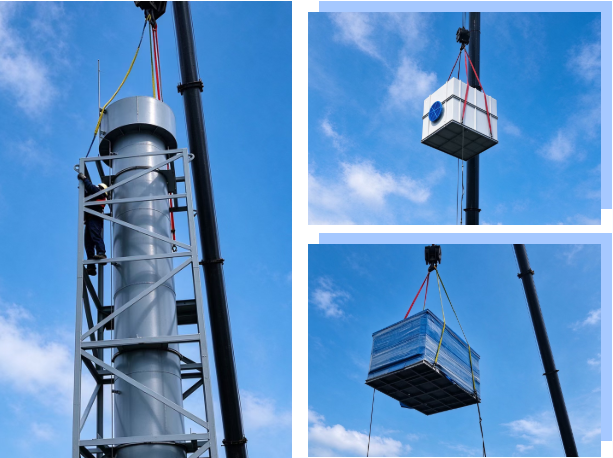
Driven by the induced draft fan, the pretreated exhaust gas is sent into a three-chamber Regenerative Thermal Oxidizer (RTO). The furnace temperature is maintained at 750–800°C, where the organic exhaust gases are completely oxidized and decomposed into harmless carbon dioxide and water.
Step 4: Compliant Emission
The purified clean gas is discharged through a chimney in compliance with emission standards.
5. Project Acceptance: Compliance with Chinese Industry Emission Standards
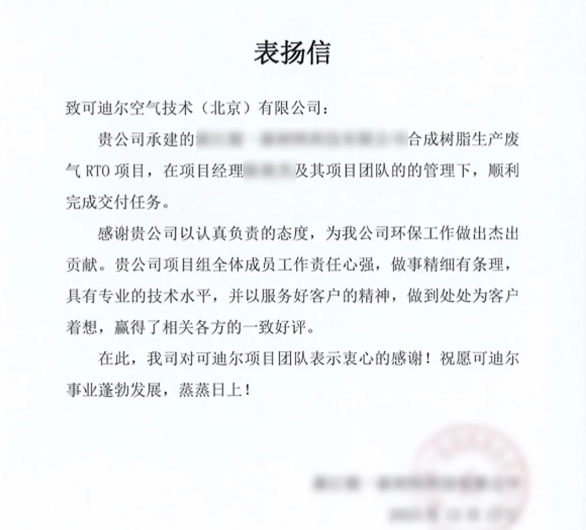
After project completion and stable commissioning of the equipment, a third-party authoritative testing agency conducted sampling and testing at the exhaust emission outlet. The test results showed that the non-methane hydrocarbon emission concentration after treatment was ≤60 mg/m³, fully complying with the national standard Emission Standard of Pollutants for Synthetic Resin Industry (GB31572-2015), and the project successfully passed environmental protection acceptance inspection.
6. Intelligent Operation & Maintenance for Long-Term Stable Emission Control
Environmental acceptance is not the end of our service. To ensure long-term efficient, stable, and safe operation of the equipment, we equipped the project with the CADAIR Intelligent Operation & Maintenance Service Platform.
Based on an intelligent control system, the platform monitors the operating status and equipment wear conditions of the exhaust gas treatment system in real time, enabling early fault warnings and instant abnormal data feedback. This significantly reduces the probability of equipment failure and downtime, helping the enterprise achieve green, safe, and long-term compliant production while safeguarding its environmental protection operations.