Meta Description
Explore carbon fiber exhaust gas treatment technologies for carbonization processes, including HCN removal, tar control, and multi-stage thermal oxidizer (TO) solutions with an engineering case study.
1. Introduction: Why Carbon Fiber Exhaust Gas Treatment Matters
As the carbon fiber industry expands, carbon fiber exhaust gas treatment has become a critical aspect of environmental compliance and plant safety. Among all stages, the carbonization process generates the most complex exhaust stream due to high temperatures and toxic components.
Effective carbonization exhaust treatment requires integrated solutions that address tar, carbon monoxide (CO), ammonia (NH₃), and hydrogen cyanide (HCN).
2. Characteristics of Carbonization Exhaust Gas
During the carbonization stage, fibers undergo pyrolysis in high-temperature inert conditions, producing exhaust gas with the following composition:
- Tar compounds (high fouling risk)
- Carbon monoxide (CO) (combustible gas)
- Ammonia (NH₃)
- Hydrogen cyanide (HCN) (toxic gas requiring careful handling)
- Particulates and trace inorganics
Key Challenges:
- High temperature (300–700°C)
- Complex and fluctuating composition
- Coexistence of toxic and combustible gases
- High risk of tar deposition and equipment blockage
These factors make industrial exhaust gas treatment for carbon fiber particularly demanding.
3. Carbon Fiber Exhaust Gas Treatment Process Flow
A widely adopted carbonization exhaust treatment system includes:
Gas collection → Quenching → Tar & dust removal → Thermal oxidizer → Heat recovery → Polishing → EmissionCore Technologies:
- Thermal Oxidizer (TO)
- Regenerative Thermal Oxidizer (RTO)
- Multi-stage Thermal Oxidizer (Multi-stage TO)
For exhaust streams with high tar content and HCN, multi-stage TO is often considered in engineering designs.
4. Multi-Stage Thermal Oxidizer (TO) for Carbon Fiber Exhaust
What is Multi-Stage TO?
A multi-stage thermal oxidizer divides the combustion process into controlled zones, improving reaction efficiency and operational stability.
Typical Stages:
1. Oxygen-Deficient Zone
- Partial pyrolysis of organics
- Helps reduce combustion intensity
- Supports tar cracking
2. Reduction Zone
- High temperature, low oxygen
- Decomposition of HCN and NH₃
- Conversion into simpler intermediates
3. Re-Oxidation Zone
- Air injection for complete oxidation
- CO and VOCs → CO₂ + H₂O
4. Cooling & Heat Recovery
- Energy recovery for reuse
- Stabilizes downstream processing
Key Advantages (Under Suitable Conditions):
- Improved handling of high-tar exhaust gas
- Supports HCN removal technology through staged reactions
- Helps reduce fouling risk
- Adapts to fluctuating gas composition
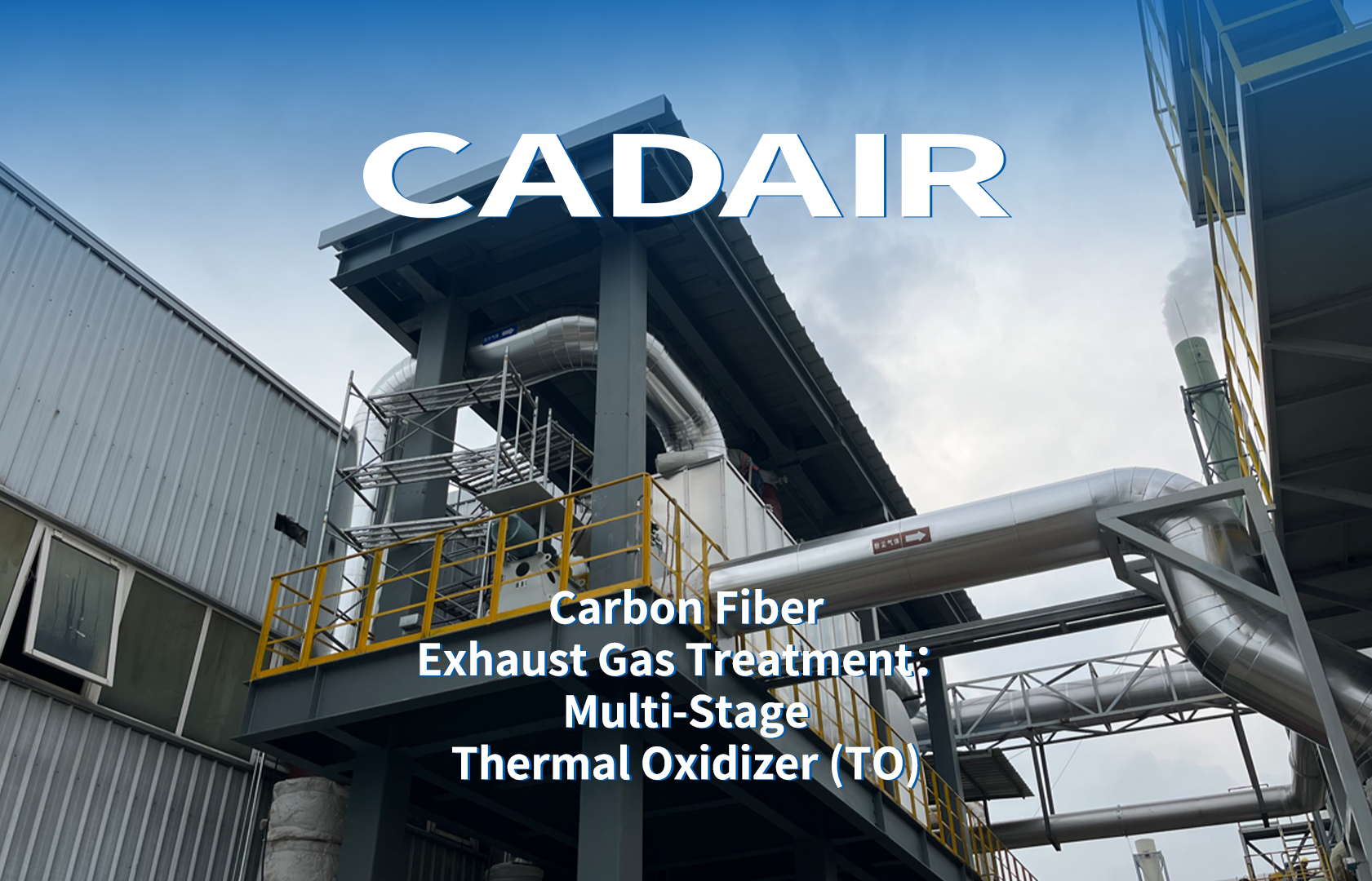
5. Engineering Case Study: Carbon Fiber Exhaust Treatment (Source: Cadair)
Project Overview
- Location: Lianyungang, Jiangsu
- Process: Carbon fiber carbonization
- Airflow: ~1,050 Nm³/h
- Temperature: 350–700°C
Exhaust Composition:
- Tar: ~55%
- CO: ~10%
- NH₃: ~9%
- Particulates: ~4%
- Trace HCN and others
This represents a typical high-tar, high-temperature industrial exhaust stream.
Process Configuration (Source: Cadair)
Dust removal + Multi-stage thermal oxidizer (TO) + Heat recovery systemObserved Technical Features (Source: Cadair)
In similar applications, multi-stage TO systems may provide:
- Capability to handle tar-rich exhaust gas
- Controlled oxidation of HCN and ammonia
- Reduced operational instability under fluctuating loads
- Potential for efficient industrial VOC and toxic gas removal
Heat recovery systems also enable reuse of thermal energy, improving overall energy efficiency.
6. When to Use Multi-Stage TO in Carbon Fiber Applications
Multi-stage TO is generally suitable for:
- Carbon fiber carbonization exhaust gas treatment
- High tar concentration exhaust streams
- Processes involving HCN removal
- High-temperature gas (>300°C)
- Variable operating conditions (multi-furnace systems)
Important Design Considerations:
- Pre-treatment (tar and dust removal) is essential
- System control is more complex than single-stage TO
- Custom engineering design is recommended
7. Conclusion: Choosing the Right Carbonization Exhaust Treatment Technology
Carbon fiber exhaust gas treatment—especially in the carbonization stage—requires a combination of safety, efficiency, and adaptability.
Multi-stage thermal oxidizers offer a structured approach to managing:
- Tar removal in industrial exhaust
- HCN and ammonia decomposition
- High-temperature gas treatment
For best results, system design should be tailored to actual process conditions, ensuring stable operation and effective emission control.