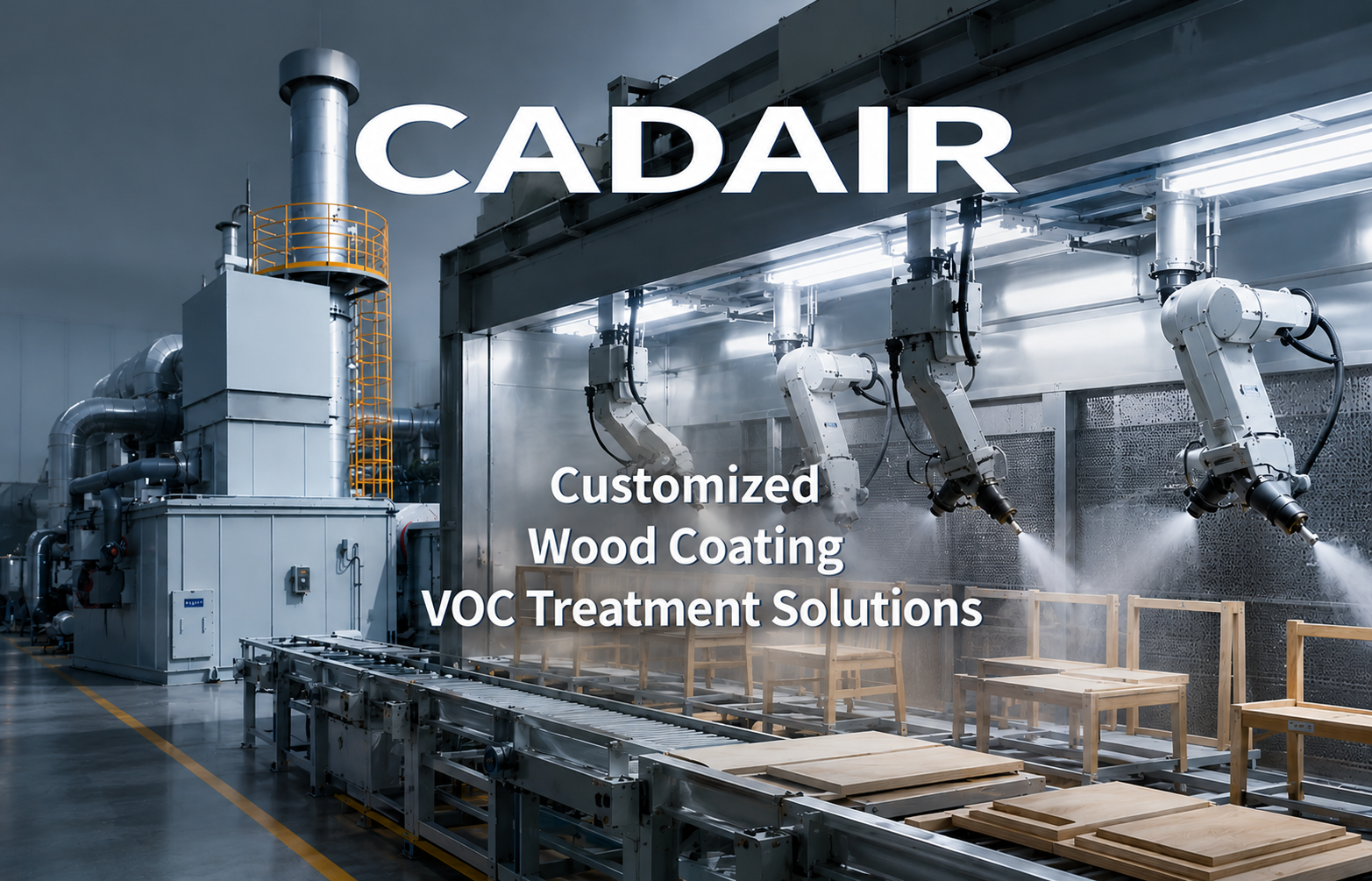
Professional VOC Treatment Solutions for the Furniture Industry
The furniture manufacturing industry is an important sector of the global light manufacturing economy. During coating, spray painting, drying and finishing processes, significant amounts of volatile organic compounds (VOCs), paint mist and wood dust may be generated. These emissions are among the primary air pollution sources in furniture production facilities.
Typical furniture coating exhaust gas is characterized by:
- Large air volume
- Relatively low VOC concentration
- Complex pollutant composition
- Intermittent and fluctuating production schedules
- Paint mist and particulate contamination
As environmental regulations continue to become more stringent worldwide, manufacturers are facing increasing pressure to reduce VOC emissions and improve environmental compliance. Standards and regulations such as China’s GB 16297, U.S. EPA requirements and European environmental directives have encouraged furniture manufacturers to adopt more efficient VOC treatment technologies.
With years of experience in industrial VOC treatment, CADAIR provides customized solutions for furniture factories, woodworking facilities and wood coating production lines worldwide.
What Causes VOC Emissions in Furniture Manufacturing?
VOC emissions are primarily generated during coating, spraying, drying, curing and solvent cleaning processes.
Common VOC compounds found in furniture manufacturing include:
| VOC Compound | Typical Source |
|---|---|
| Toluene | Solvent-based coatings |
| Xylene | Paints and thinners |
| Ethyl Acetate | Spray coating processes |
| Butyl Acetate | Wood finishing coatings |
| MEK (Methyl Ethyl Ketone) | Cleaning operations |
| Ethanol | Certain coating formulations |
Besides VOCs, furniture coating exhaust streams may also contain:
- Paint mist particles
- Wood dust
- Aerosols
- Resin-related organic compounds
Because of these characteristics, effective pretreatment is often considered a critical component of any furniture VOC treatment system.
Main Challenges of Wood Coating VOC Treatment
1. Paint Mist and Dust Blockage
Furniture coating exhaust gas frequently contains paint mist, wood dust and sticky organic particles that can accumulate inside filters, ducts, adsorbents, catalysts and heat exchangers.
Without effective pretreatment, equipment performance may gradually decline and maintenance requirements may increase.
2. Fluctuating Production Conditions
Furniture production is typically carried out in batches. Changes in production schedules can lead to significant fluctuations in air volume and VOC concentration.
Treatment systems must be capable of adapting to varying operating conditions while maintaining stable performance.
3. Balancing Compliance and Energy Consumption
Most furniture coating facilities generate high-volume, low-concentration VOC emissions. Direct treatment of large air volumes can increase energy consumption and operating costs.
4. Catalyst and Adsorbent Protection
Certain organic compounds and paint-related contaminants may affect catalyst activity and adsorption performance over time if pretreatment is insufficient.
5. Safety and Regulatory Compliance
Furniture coating workshops often involve flammable solvents and combustible materials. VOC treatment equipment must meet applicable safety requirements related to fire prevention, explosion protection and industrial operation.
What Is the Optimal VOC Treatment Technology for Furniture Manufacturing?
There is no single VOC treatment technology suitable for every furniture manufacturing facility.
The optimal solution depends on:
- Air volume
- VOC concentration
- Production schedule
- Coating materials
- Local emission regulations
- Energy costs
- Available installation space
For many medium and large furniture manufacturing facilities, Zeolite Rotor Concentration combined with Thermal Oxidation technology is widely adopted because it can effectively concentrate low-concentration VOC emissions before final treatment, helping improve overall energy efficiency.
Technology selection should always be based on actual operating conditions and lifecycle operating costs rather than equipment investment alone.
Comparison of Mainstream Furniture VOC Treatment Technologies
| Technology | Advantages | Limitations | Typical Applications |
|---|---|---|---|
| Activated Carbon Adsorption | Low initial investment and simple operation | Requires periodic replacement and may generate hazardous waste | Small workshops and intermittent operations |
| Catalytic Oxidation (CO) | Lower operating temperature and relatively low fuel consumption | Requires effective pretreatment and clean exhaust gas | Stable medium-concentration VOC streams |
| Regenerative Thermal Oxidizer (RTO) | High destruction efficiency and broad applicability | Higher investment and greater system complexity | Continuous industrial production |
| Zeolite Rotor + RTO | Suitable for large air volume and low-concentration VOC emissions | Requires customized engineering design | Furniture, coating and electronics industries |
| Zeolite Rotor + CO | Improved energy efficiency under suitable conditions | Catalyst protection is critical | Medium-scale VOC treatment projects |
CADAIR Customized Wood Coating VOC Treatment Solutions
Based on extensive industrial VOC treatment experience, CADAIR provides integrated solutions specifically designed for furniture coating applications.
1. Intelligent Pretreatment System
The pretreatment stage combines mechanical filtration, demisting and particulate removal technologies to reduce paint mist and dust before the exhaust gas enters downstream treatment equipment.
Under suitable operating conditions, paint mist removal efficiency can typically reach 90%–99%, helping protect downstream equipment and reduce maintenance requirements.
2. High-Efficiency Zeolite Rotor Concentration System
The zeolite rotor system is designed to capture and concentrate dilute VOC streams.
Depending on operating conditions and exhaust gas characteristics, VOC adsorption efficiency can typically reach 90%–98%, significantly reducing the air volume sent to oxidation equipment.
The system is particularly suitable for high-air-volume, low-concentration exhaust gas generated by furniture coating workshops.
3. Intelligent Oxidation System
CADAIR can configure either Regenerative Thermal Oxidizers (RTO) or Catalytic Oxidation (CO) systems according to project requirements.
Properly designed VOC treatment systems can typically achieve overall VOC removal efficiencies of 95%–99%, depending on pollutant characteristics, operating conditions and regulatory requirements.
The intelligent control system continuously monitors process parameters and adjusts operation based on changing production conditions.
4. Waste Heat Recovery
Thermal oxidation processes generate valuable heat energy that can potentially be recovered and reused for:
- Workshop heating
- Drying ovens
- Hot water generation
- Process heating applications
Depending on project conditions, optimized heat recovery systems may help reduce overall energy consumption and operating costs.
5. Customized Engineering Services
CADAIR provides:
- Site investigation
- Emission testing support
- Process design
- Equipment manufacturing
- Installation and commissioning
- Operation and maintenance services
Each solution is customized according to actual production conditions and local environmental requirements.
Frequently Asked Questions
Q1: Which is better for wood coating VOC treatment, RTO or CO?
Neither technology is universally better.
RTO systems are commonly selected for high-air-volume and continuous production applications because they can handle a wide variety of VOC compounds.
CO systems operate at lower temperatures and may offer lower fuel consumption under suitable conditions. However, catalyst protection is critical.
Technology selection should be based on site-specific operating conditions.
Q2: How can paint mist blockage be minimized?
Effective pretreatment is the key.
Multi-stage filtration, demisting systems and regular maintenance programs can significantly reduce the risk of paint mist accumulation and protect downstream treatment equipment.
Q3: What is the typical payback period for VOC treatment equipment?
The investment payback period varies depending on production scale, operating hours, energy prices, heat recovery utilization and local compliance requirements.
In many industrial applications, payback periods may range from approximately 1 to 5 years.
Q4: Can the system comply with international environmental standards?
VOC treatment systems can be designed according to applicable local regulations and project requirements. Compliance requirements should always be evaluated based on the target market and installation location.
Q5: Can the system handle fluctuating production schedules?
Yes. Modern control systems can automatically adjust operating parameters based on changes in air volume and VOC concentration, helping maintain stable treatment performance under varying production conditions.
Why Choose CADAIR?
CADAIR focuses on industrial VOC treatment technologies for coating, furniture manufacturing, electronics, semiconductors, chemical processing and other industries.
Through customized engineering, integrated treatment systems and lifecycle technical support, CADAIR helps manufacturers improve environmental performance, enhance operational efficiency and meet evolving emission requirements.
For furniture manufacturers seeking reliable wood coating VOC treatment solutions, CADAIR provides professional engineering support tailored to real operating conditions and project objectives.