Petroleum refining and chemical feedstocks underpin all aspects of production and daily life, from everyday plastic products, synthetic fibers and electronic components to automotive tires and industrial consumables. China’s refining and chemical industry is undergoing rapid upgrading toward large-scale and intensified development, continuously underpinning the steady growth of the industrial economy.

Meanwhile, volatile organic waste gases are continuously generated across all production processes of petroleum refining and chemical wastewater treatment. Coupled with the industry characteristics of variable operating conditions and highly corrosive media in petrochemical production, achieving stable waste gas treatment is extremely challenging. As environmental control standards continue to tighten, traditional single-type treatment equipment has limited adaptability and insufficient operational stability, making it difficult to meet the requirements of long-term operation, ultra-low emission, and safe & green production in petrochemical plants.
Operating Condition Challenges
This project treats mixed waste gas from multiple sources at a petrochemical wastewater plant, including high-concentration waste gas from storage tanks, low-concentration waste gas from air flotation tanks, and waste gas from IBR biochemical units. With intertwined and superimposed gas streams, the operating conditions are highly complex, presenting four major treatment difficulties:
- Complex composition with strong odor The waste gas contains pollutants such as benzene series, sulfides and non-methane total hydrocarbons (NMHC). With the superimposition of VOCs and malodorous substances, simultaneous removal of pollutants and odor is required.
- Large concentration fluctuations and strong condition shocks Affected by production condition switching, waste gas concentration fluctuates frequently. Conventional equipment is prone to efficiency instability and unreliable compliance performance.
- Large air volume continuous operation with high stability requirements With a treatment air volume of 25,000 Nm³/h, the system must support 8,400 hours of continuous operation per year, imposing strict requirements on equipment durability and fatigue resistance.
- Corrosive media leading to rapid equipment wear The waste gas entrains acidic gases with strong corrosiveness, causing conventional equipment to age and deteriorate easily, resulting in higher operation & maintenance costs and safety risks.
Process Route
Addressing the unique operating conditions of petrochemical wastewater waste gas — multiple gas sources, strong fluctuations, corrosiveness and high odor — this project adopts an integrated combined process of low-temperature diesel absorption + alkaline washing desulfurization + concentration homogenization + three-bed RTO regenerative thermal oxidation. Following the closed-loop treatment logic of “front-end pretreatment, mid-end condition stabilization, and end-end deep oxidation”, it resolves the core pain points at the source.
Treatment Processes
Low-temperature Diesel Absorption
Recovers oil and gas from high-concentration waste gas, initially reducing VOCs concentration and stabilizing inlet gas conditions.
Alkaline Washing Desulfurization
Removes sulfides and odorous components from the waste gas, eliminates corrosive gases, protects the downstream RTO equipment, and ensures compliance of subsequent SO₂ emissions.
Concentration Homogenization
Fully mixes and homogenizes waste gas from multiple sources with varying concentrations, avoids concentration shocks, and ensures stable concentration of waste gas entering the RTO.
Three-bed RTO Regenerative Thermal Oxidation
The homogenized waste gas enters the RTO furnace and retains sufficient residence time in the high-temperature zone for oxidation, where VOCs are completely decomposed into CO₂ and H₂O.
Core Project Advantages
Ultra-high purification efficiency with strict ultra-low emission control
The RTO system achieves a heat recovery rate of ≥95% and a VOCs purification efficiency of ≥99%. Verified by third-party testing, all waste gas emission indicators comprehensively outperform the Emission Standard of Pollutants for Petroleum Refining Industry (GB31570-2015):
Actual emissions vs. GB 31570-2015 limits:
- NMHC: ≤20 mg/Nm³ (standard: ≤120 mg/Nm³)
- Benzene: ≤2 mg/Nm³ (standard: ≤4 mg/Nm³)
- Toluene: ≤8 mg/Nm³ (standard: ≤15 mg/Nm³)
- Xylene: ≤10 mg/Nm³ (standard: ≤20 mg/Nm³)
- Nitrogen oxides: ≤70 mg/Nm³ (standard: ≤100 mg/Nm³)
Self-sustaining heating operation with significantly reduced operating costs
After reaching stable operation, the system can run in full thermal balance self-sustaining mode without additional fuel consumption.
Petrochemical-grade intrinsic safety with full-link protection system
The equipment adopts intrinsic safety design and graded anti-corrosion materials to adapt to corrosive operating conditions. The whole unit meets the Exd II BT4 Gb explosion-proof grade, and is equipped with SIL2-level concentration monitoring, overpressure explosion venting, and multi-stage interlock protection systems. It comprehensively mitigates operational safety risks and is suitable for high-risk petrochemical production scenarios.
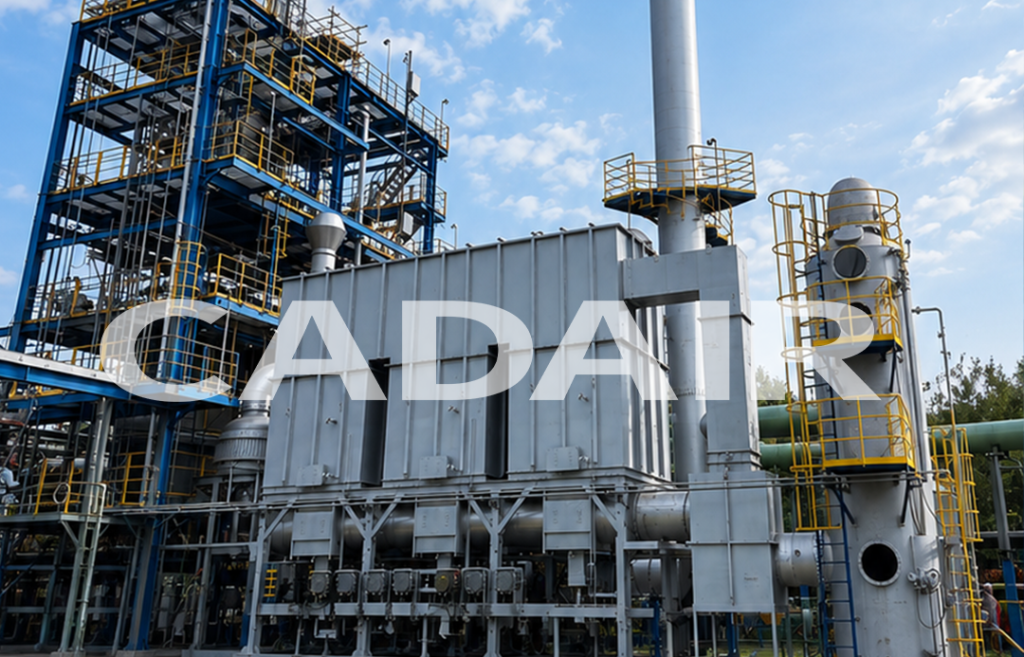
The project has passed reliability assessment and third-party testing verification. The entire system operates stably, delivers strong condition adaptability and excellent odor treatment performance, and maintains stable compliance across all emission indicators. It has successfully passed acceptance and entered normal continuous operation.