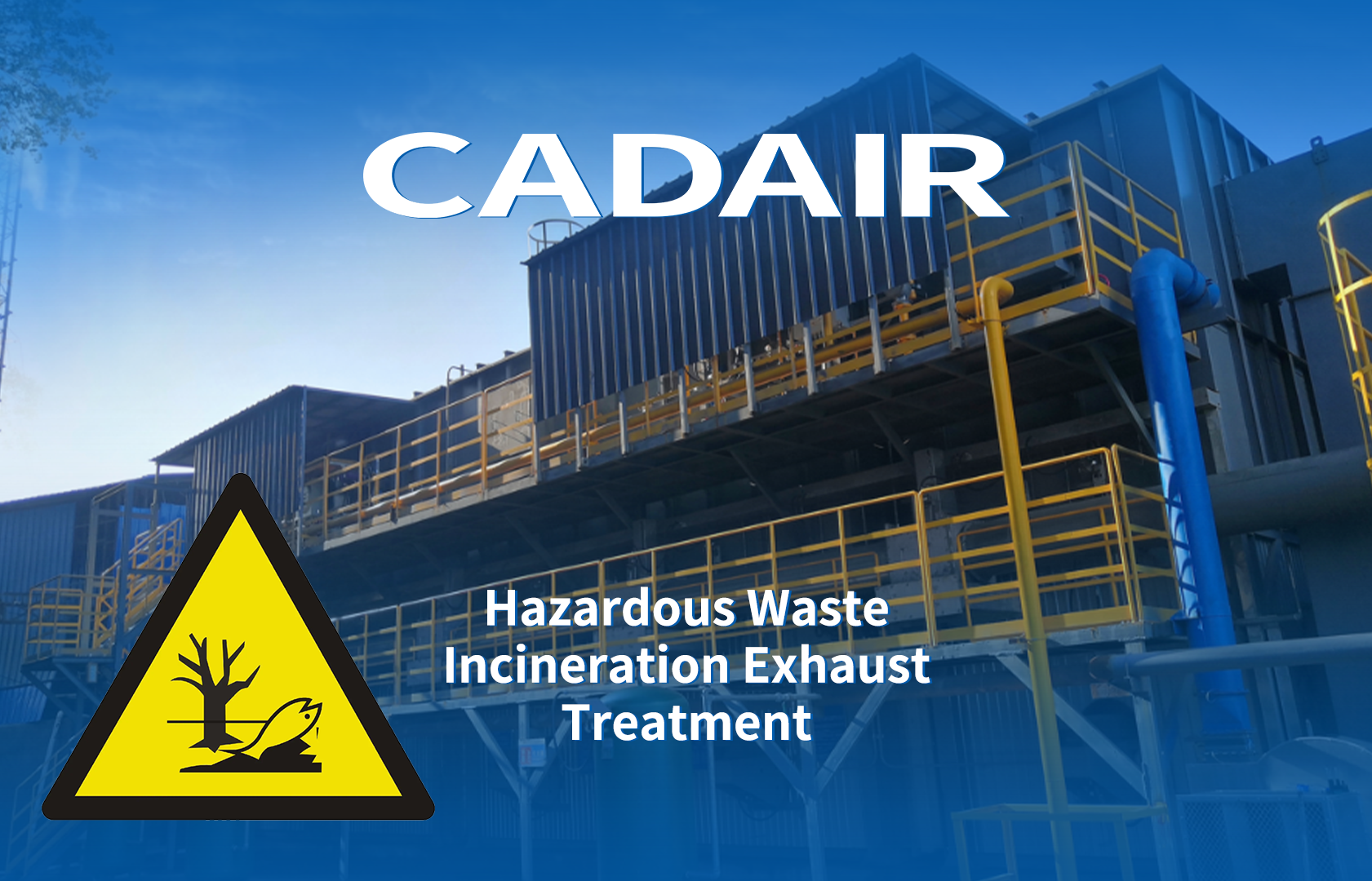
Introduction
Hazardous waste incineration and rotary kiln roasting processes generate complex flue gases containing high concentrations of carbon monoxide (CO), sulfur dioxide (SO₂), nitrogen oxides (NOₓ), hydrogen chloride (HCl), hydrogen fluoride (HF), volatile organic compounds (VOCs), and even dioxins.
As environmental regulations such as China’s GB 18484-2020 Standard for Pollution Control on Hazardous Waste Incineration become increasingly stringent, industrial facilities must adopt integrated exhaust gas treatment systems capable of achieving long-term emission compliance while minimizing operating costs.
CADAIR specializes in hazardous waste flue gas treatment solutions that combine multi-bed Regenerative Thermal Oxidizers (RTO), advanced dust removal, desulfurization, denitrification, and waste heat recovery technologies. Through multiple successful projects across China, CADAIR has demonstrated how hazardous waste incineration exhaust can be transformed from an environmental liability into a source of recoverable energy.
What Are the Main Challenges in Hazardous Waste Incineration Flue Gas Treatment?
Hazardous waste streams such as:
- Electroplating sludge
- Chemical residues
- Metal smelting waste
- Industrial solid waste
- Pyrolysis by-products
typically produce exhaust gases with several treatment challenges:
High CO Concentrations
Carbon monoxide concentrations often range from 3,000 to 10,000 mg/m³, creating both environmental and safety concerns.
Multiple Pollutants in One Exhaust Stream
A single exhaust stream may contain:
- CO
- VOCs
- SO₂
- NOₓ
- HCl
- HF
- Dioxins
- Particulate matter
Traditional single-stage treatment systems struggle to remove all pollutants simultaneously.
Large Concentration Fluctuations
Hazardous waste composition varies significantly, causing unstable gas concentrations and temperature fluctuations.
Energy Loss
Without heat recovery systems, large amounts of thermal energy are wasted, increasing fuel consumption and operating costs.
Why Multi-Bed RTO Is the Preferred Solution for Hazardous Waste Exhaust Treatment
A multi-bed Regenerative Thermal Oxidizer (RTO) is widely recognized as one of the most effective technologies for treating high-concentration CO and VOC emissions from hazardous waste incineration.
Key advantages include:
- CO removal efficiency above 99%
- VOC destruction efficiency above 99%
- Stable operation under fluctuating gas loads
- Low auxiliary fuel consumption
- High thermal recovery efficiency
- Capability to integrate with waste heat boilers
For large-scale hazardous waste treatment facilities, 3-bed and 5-bed RTO systems provide continuous operation while maintaining optimal combustion temperatures above 800°C.
CADAIR Integrated Hazardous Waste Flue Gas Treatment Process
CADAIR has developed a complete treatment process designed specifically for hazardous waste incineration exhaust.
Step 1: High-Efficiency Baghouse Dust Collection
Before entering the RTO, exhaust gas passes through a high-performance bag filter.
Benefits include:
- Removal of particulate matter
- Protection of ceramic heat storage media
- Prevention of clogging and high-temperature fouling
- Extended RTO service life
Step 2: Multi-Bed RTO Thermal Oxidation
The purified gas enters a 2-bed, 3-bed, or 5-bed RTO system.
Inside the oxidation chamber:
- CO is converted into CO₂
- VOCs are destroyed
- Organic hazardous compounds are decomposed
- Dioxin precursors are significantly reduced
The process achieves extremely high destruction efficiency while maintaining stable operation under changing process conditions.
Step 3: Advanced Desulfurization and Denitrification
Following thermal oxidation, downstream treatment removes remaining pollutants through:
- Alkaline wet scrubbing
- Desulfurization systems
- SCR denitrification
- SNCR denitrification
This ensures compliance with GB 18484-2020 and local emission requirements.
Step 4: Waste Heat Recovery
Recovered thermal energy can be used for:
- Steam generation
- Process heating
- Boiler feedwater heating
- Plant energy optimization
This significantly reduces operating costs and improves project ROI.
Project Case: 100,000 m³/h Electroplating Sludge Incineration Exhaust Treatment in Zhejiang
One of CADAIR’s benchmark projects involved treating high-CO exhaust generated during electroplating sludge incineration.
Project Overview
Location: Ningbo, Zhejiang
Treatment Capacity:
100,000 m³/h
Main Pollutants:
- CO (3,000–10,000 mg/m³)
- SO₂
- Halogen-containing gases
- Organic compounds
System Configuration:
- High-efficiency baghouse filter
- Five-bed RTO
- Desulfurization system
- Denitrification system
- Waste heat recovery boiler
Results
The project achieved:
- Over 99% CO removal efficiency
- Stable compliance with national emission standards
- Annual reduction of approximately 8,500 tons of CO emissions
- Annual steam production of 17,000 tons
Through waste heat recovery, the facility generates approximately RMB 3.4 million in annual economic benefits.
Additional Hazardous Waste Exhaust Treatment Projects
Jiangsu High-CO Flue Gas Treatment Project
A 60,000 Nm³/h hazardous waste pyrolysis exhaust treatment system utilizing a 2-bed RTO provides stable long-term compliance for non-ferrous metal production operations.
Guangdong Large-Airflow Hazardous Waste Facility
A 110,000 m³/h exhaust treatment project employs a five-bed RTO to handle high oxygen content, high humidity, SO₂, and CO simultaneously.
Inner Mongolia Hazardous Waste Treatment Project
A corrosion-resistant 3-bed RTO system was implemented to treat exhaust containing:
- NOₓ
- HCl
- HF
- Dioxins
ensuring reliable operation under highly corrosive conditions.
Economic Benefits of Waste Heat Recovery in Hazardous Waste Incineration
Many industrial operators focus solely on emission compliance. However, waste heat recovery can significantly improve project economics.
Benefits include:
- Reduced natural gas consumption
- Lower operating expenses
- Increased steam production
- Faster investment payback
- Improved sustainability performance
For facilities with high CO concentrations, recovered combustion heat often becomes a valuable secondary energy source.
Why Choose CADAIR for Hazardous Waste Exhaust Treatment?
CADAIR provides complete turnkey solutions for:
- Hazardous waste incineration exhaust treatment
- High-concentration CO waste gas treatment
- VOC abatement systems
- Multi-bed RTO systems
- Desulfurization and denitrification systems
- Waste heat recovery engineering
With successful projects ranging from 5,000 m³/h to 110,000 m³/h, CADAIR delivers customized systems that balance environmental compliance, energy efficiency, and long-term operating reliability.
Frequently Asked Questions (FAQ)
What is the best technology for high-concentration CO waste gas treatment?
Multi-bed RTO systems are widely considered one of the most effective technologies for achieving over 99% CO destruction efficiency while recovering thermal energy.
Can RTO systems remove dioxins?
RTO systems can effectively destroy many organic compounds and reduce dioxin precursors. Additional downstream purification may be required depending on regulatory requirements.
What industries require hazardous waste exhaust treatment?
Common industries include:
- Electroplating
- Non-ferrous metal smelting
- Chemical manufacturing
- Hazardous waste disposal
- Resource recycling
- Industrial waste treatment
How does waste heat recovery improve project economics?
Recovered thermal energy can be converted into steam or process heat, reducing fuel costs and generating measurable annual savings.
Conclusion
Hazardous waste incineration exhaust treatment requires more than simple air pollution control equipment. An integrated system combining multi-bed RTO technology, advanced purification processes, and waste heat recovery is essential for achieving modern environmental compliance and operational efficiency.
Through extensive project experience across China, CADAIR has demonstrated that hazardous waste exhaust can be treated safely, efficiently, and profitably, helping industrial facilities meet emission targets while maximizing energy recovery.