As the global electric vehicle (EV) and energy storage markets continue to expand, China has become one of the world’s leading lithium-ion battery manufacturing centers. Alongside this growth, environmental compliance and VOC emission control have become increasingly important for battery manufacturers seeking sustainable production.
Processes such as electrode coating, drying, electrolyte filling, and solvent recovery can generate volatile organic compounds (VOCs), NMP tail gas, and electrolyte-related emissions. Effective exhaust gas treatment is essential for meeting environmental standards, protecting workplace safety, and improving operational sustainability.
CADAIR specializes in industrial air pollution control solutions and has provided customized exhaust gas treatment systems for leading battery manufacturers in China. The following projects demonstrate how different technologies can be applied to address the unique challenges of lithium battery production.
CATL Project: VOC Treatment with Zeolite Rotor and Catalytic Oxidation
CATL is one of the world’s largest manufacturers of lithium-ion batteries for electric vehicles and energy storage applications.
Project Overview
- Exhaust Components: Benzene, Toluene, Xylene, n-Hexane
- Air Volume: 7,000 Nm³/h × 3 systems
- Treatment Technology: Zeolite Rotor Concentrator + Catalytic Oxidation (CO)
Challenge
The exhaust gas mainly originated from NMP recovery systems and electrode coating and drying processes. The emissions featured:
- Large air volume
- Low VOC concentration
- Complex solvent composition
- Strict environmental requirements
For this type of exhaust stream, conventional thermal treatment systems often result in higher operating costs and energy consumption.
Solution
CADAIR implemented a Zeolite Rotor Concentrator combined with Catalytic Oxidation technology.
The zeolite rotor captures and concentrates VOCs from large volumes of process air. The concentrated gas stream is then directed to a catalytic oxidation unit, where pollutants are decomposed into carbon dioxide (CO₂) and water (H₂O) at relatively low temperatures.
Results
- VOC removal efficiency exceeding 98%
- Reduced energy consumption
- No significant secondary pollution
- Suitable for NMP tail gas, coating, and drying applications
This technology has become a widely adopted solution for low-concentration, high-air-volume VOC treatment in lithium battery manufacturing facilities.
Lishen Battery Project: Electrolyte Exhaust Treatment with RTO Technology
Lishen Battery is one of China’s earliest lithium-ion battery manufacturers, supplying batteries for electric vehicles, energy storage systems, and consumer electronics.
Project Overview
- Exhaust Components: Ethylene Carbonate (EC), Ethyl Methyl Carbonate (EMC), Dimethyl Carbonate (DMC), Lithium Hexafluorophosphate (LiPF₆)
- Air Volume: 40,000 m³/h
- Treatment Technology: Three-Bed Regenerative Thermal Oxidizer (RTO)
Challenge
Electrolyte-related emissions present several treatment challenges, including:
- High boiling-point compounds
- Potential condensation and polymerization
- Corrosive characteristics
- Complex exhaust composition
These factors require a robust and reliable treatment system capable of maintaining stable long-term operation.
Solution
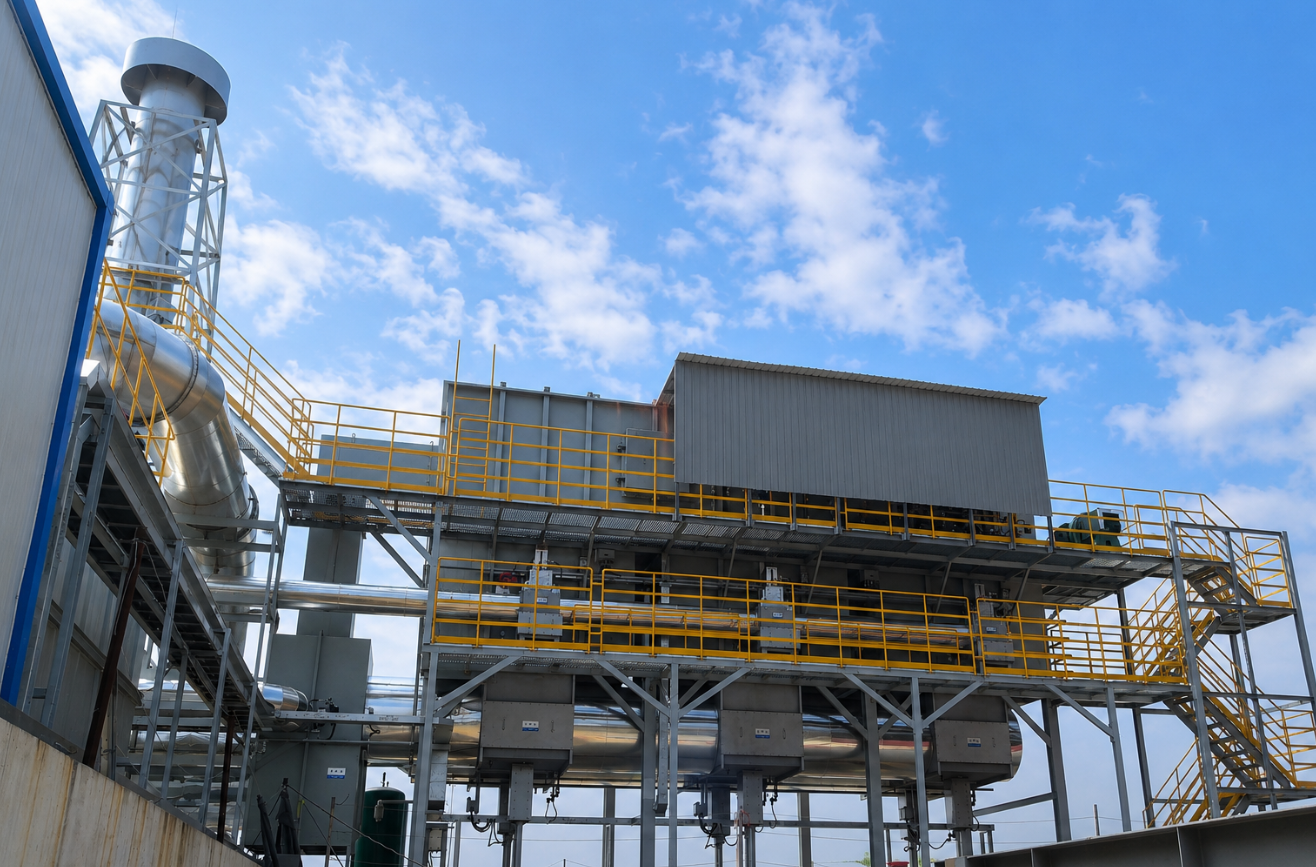
CADAIR designed a three-bed Regenerative Thermal Oxidizer (RTO) system specifically for this application.
The system utilizes ceramic heat storage media to recover thermal energy while maintaining high oxidation temperatures. Organic pollutants are completely decomposed, and recovered heat is reused within the process to improve overall energy efficiency.
Results
- VOC removal efficiency above 99%
- Suitable for medium- and high-concentration organic emissions
- High thermal recovery efficiency
- Lower long-term operating costs
RTO technology remains one of the most widely used and proven solutions for electrolyte exhaust and VOC treatment in lithium battery production facilities.
How to Choose the Right VOC Treatment Technology for Lithium Battery Manufacturing
Different battery production processes generate different types of emissions. Selecting the appropriate treatment technology depends on VOC concentration, airflow volume, and exhaust composition.
| Emission Type | Recommended Technology |
|---|---|
| Low-concentration, high-air-volume VOCs | Zeolite Rotor + Catalytic Oxidation |
| Medium- to high-concentration VOCs | RTO |
| Electrolyte exhaust gas | Scrubber + RTO Combination |
| NMP tail gas | NMP Recovery + VOC Polishing System |
A properly designed treatment system can improve emission control performance while reducing operational costs and energy consumption.
Why Battery Manufacturers Choose CADAIR
CADAIR provides customized air pollution control solutions for lithium battery manufacturers, energy storage battery producers, and battery material suppliers.
Core technologies include:
- Zeolite Rotor Concentration Systems
- Catalytic Oxidation (CO)
- Regenerative Thermal Oxidizers (RTO)
- Chemical Scrubbers
- Integrated VOC Treatment Systems
With experience serving industry-leading companies such as CATL, Lishen Battery, and Envision Energy, CADAIR helps manufacturers achieve efficient VOC control, energy savings, and reliable environmental compliance.
Conclusion
As environmental regulations continue to tighten worldwide, exhaust gas treatment has become a critical component of sustainable lithium battery manufacturing.
The CATL and Lishen Battery projects demonstrate how Zeolite Rotor Concentration, Catalytic Oxidation, and Regenerative Thermal Oxidation technologies can effectively address VOC emissions generated during battery production.
Through proven engineering expertise and customized solutions, CADAIR continues to support battery manufacturers in reducing emissions, improving environmental performance, and advancing cleaner industrial development.
Keywords: lithium battery exhaust gas treatment, lithium-ion battery VOC control, battery manufacturing emission control, NMP tail gas treatment, electrolyte exhaust treatment, VOC abatement system, regenerative thermal oxidizer (RTO), zeolite rotor concentrator, catalytic oxidation, industrial air pollution control, China lithium battery manufacturing, battery factory VOC treatment, CADAIR.