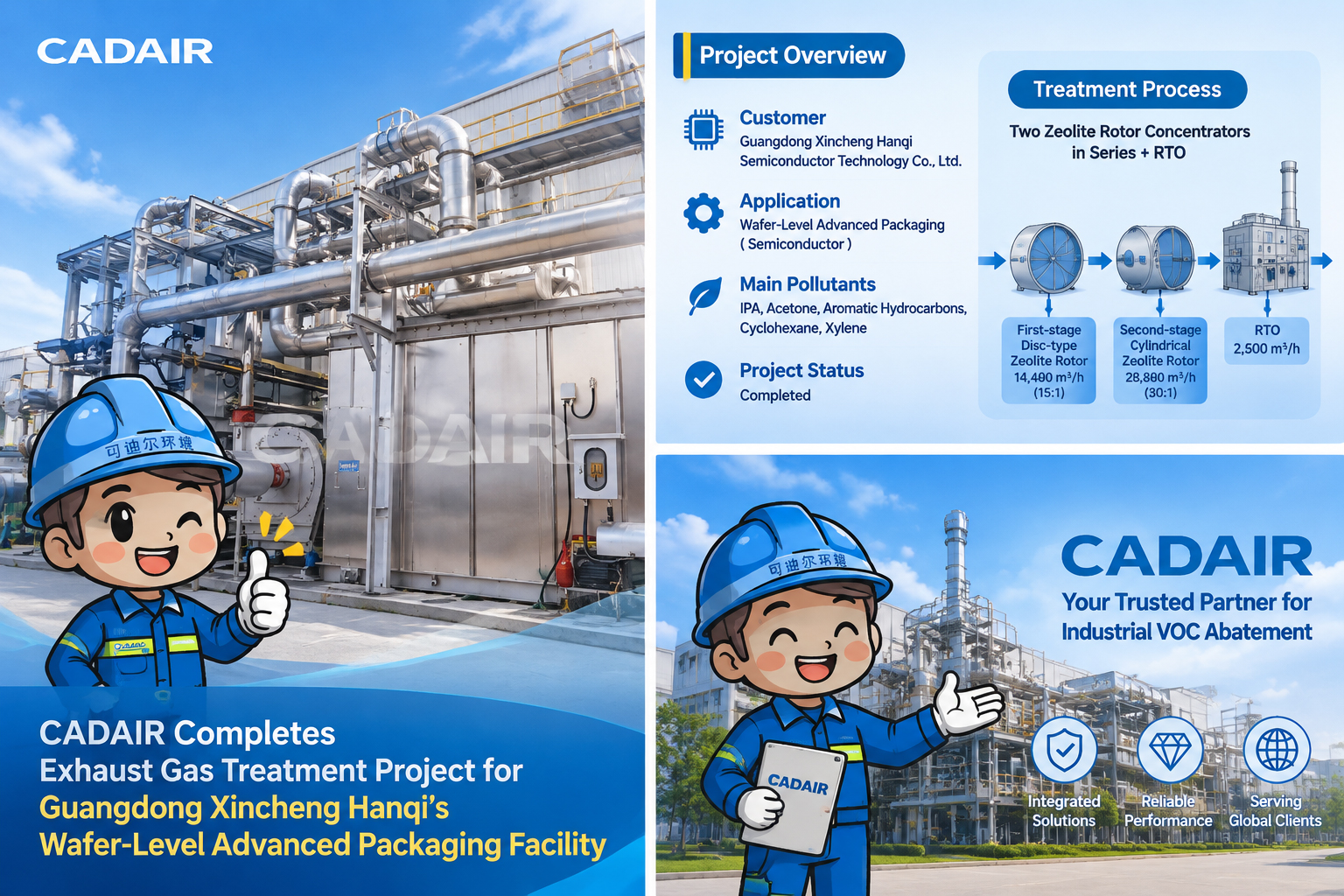
CADAIR has successfully completed an industrial exhaust gas treatment project for Guangdong Xincheng Hanqi Semiconductor Technology Co., Ltd. at its wafer-level advanced packaging and testing facility in Songshan Lake, Dongguan, China. The project features a two-stage zeolite rotor concentration system integrated with a regenerative thermal oxidizer (RTO) to treat complex VOC emissions generated during semiconductor packaging and testing processes.
As semiconductor manufacturing technologies continue to advance, wafer-level packaging and advanced testing processes are creating increasingly complex requirements for industrial exhaust gas treatment. Multiple organic solvents, varying exhaust concentrations, and different operating conditions require carefully engineered VOC abatement systems.
For semiconductor manufacturers, selecting an appropriate exhaust gas treatment system involves more than choosing individual environmental protection equipment. Process compatibility, equipment integration, and overall engineering capabilities are equally important.
1. Project Overview: VOC Treatment for Wafer-Level Semiconductor Packaging
The project serves Guangdong Xincheng Hanqi Semiconductor Technology Co., Ltd., whose facility specializes in wafer-level advanced semiconductor packaging and testing.
During production, various organic solvents are used, generating industrial exhaust gas containing multiple volatile organic compounds (VOCs), including:
- Isopropyl Alcohol (IPA)
- Acetone
- Aromatic Hydrocarbons
- Cyclohexane
- Xylene
These different VOC components present specific requirements for exhaust collection, pretreatment, adsorption, concentration, and subsequent oxidation.
To address the characteristics of the exhaust streams, CADAIR undertook the overall exhaust gas treatment engineering scope, including process design, equipment manufacturing, and project implementation.
2. What VOC Treatment Technology Was Used in This Semiconductor Project?
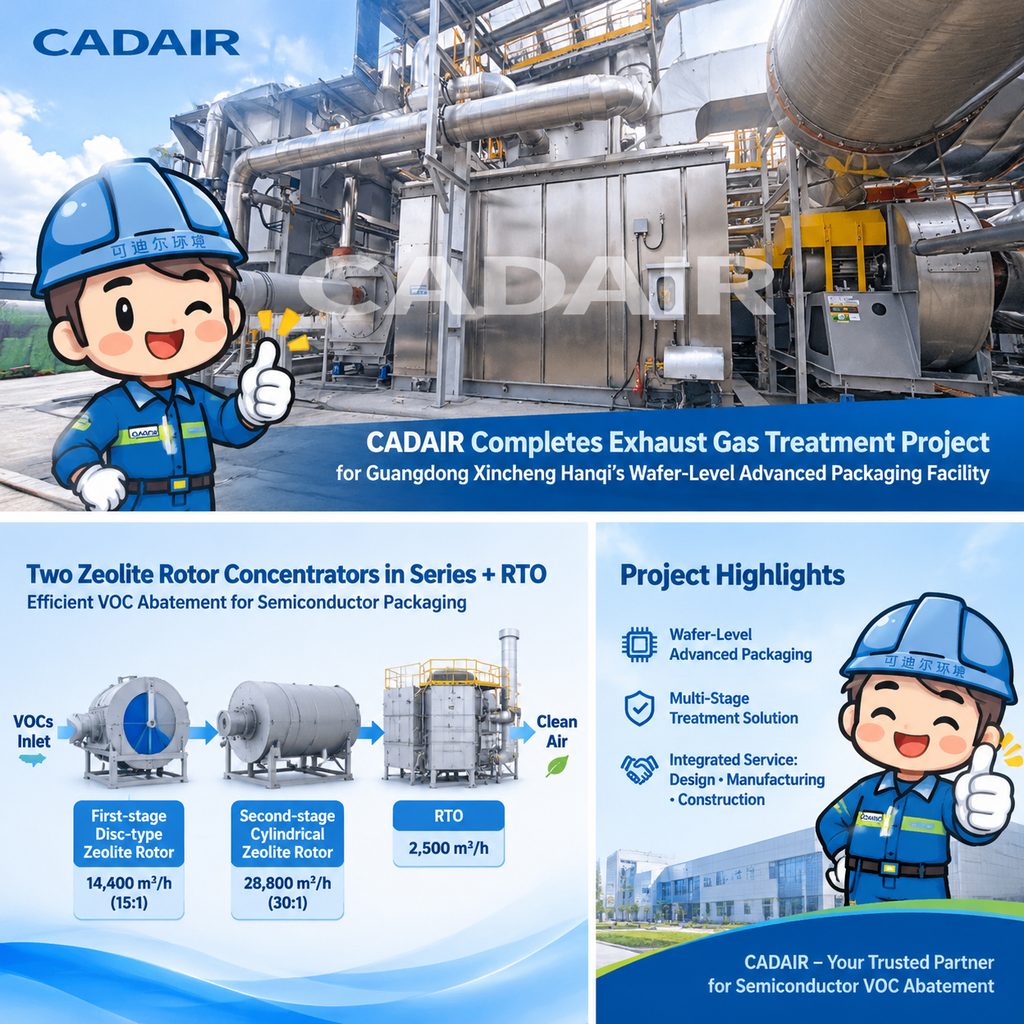
CADAIR implemented a treatment configuration combining two zeolite rotor concentrators in series with a regenerative thermal oxidizer (RTO).
The system integrates adsorption and desorption processes to concentrate VOCs before sending the concentrated exhaust to the downstream oxidation unit.
The main equipment configuration is as follows:
First-stage disc-type zeolite rotor:14,400 m³/h
Second-stage cylindrical zeolite rotor:28,800 m³/h
Regenerative Thermal Oxidizer (RTO):2,500 m³/h
The two zeolite rotor units are arranged in series, followed by the RTO as the final oxidation treatment stage.
This configuration combines two stages of VOC concentration with downstream thermal oxidation, helping reduce the airflow entering the oxidation system while adapting to the characteristics of the semiconductor production exhaust.
How Does a Zeolite Rotor Concentrator Work?
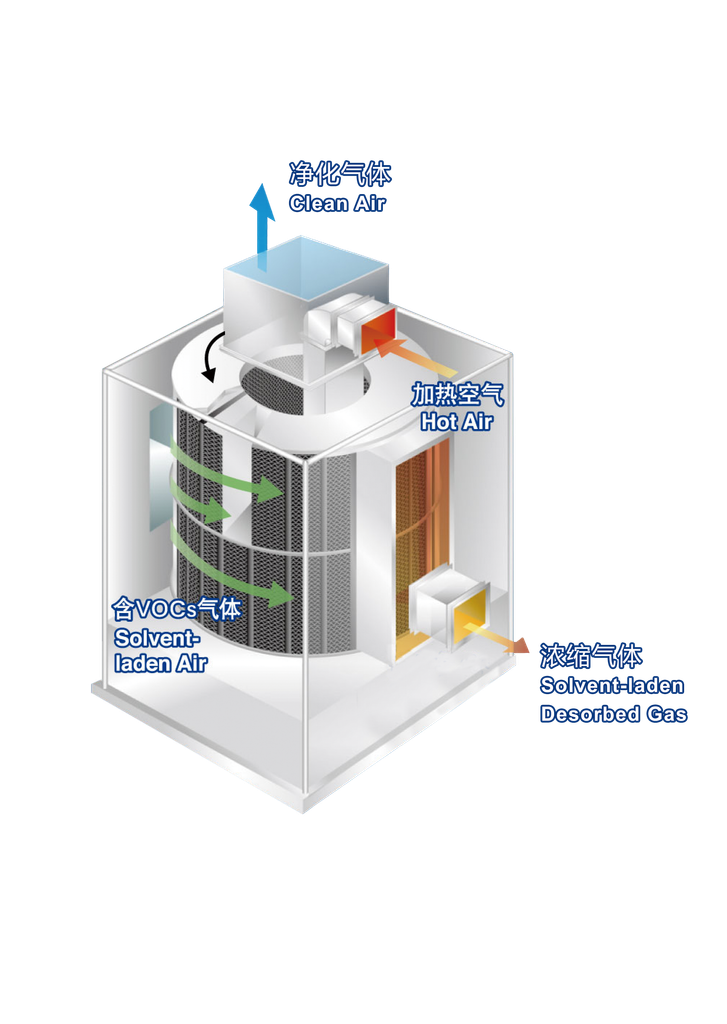
A zeolite rotor concentrator is an industrial VOC treatment device that uses adsorption and desorption to separate and concentrate organic compounds from exhaust gas.
During operation, VOCs are adsorbed onto the zeolite media as the exhaust passes through the rotor. The rotor then enters a desorption zone, where heated air releases the adsorbed VOCs into a smaller, more concentrated airflow.
This process reduces the airflow requiring subsequent oxidation treatment and allows the downstream system to be configured according to the concentrated exhaust characteristics.
For applications involving multiple organic solvents, selecting an appropriate rotor configuration and integrating it with the oxidation system are important considerations in overall process engineering.
Why Combine Zeolite Rotor Concentration with RTO?
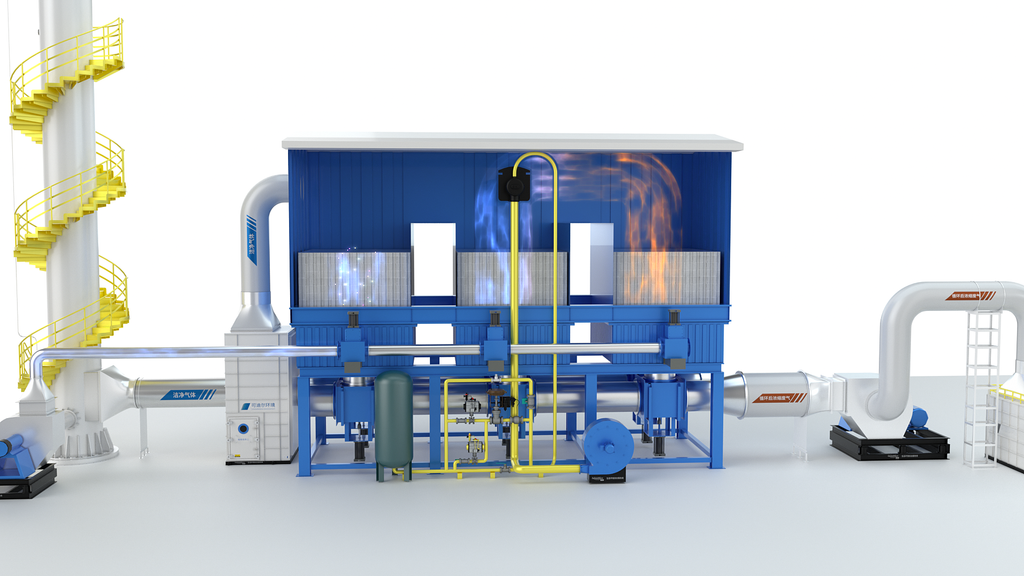
A regenerative thermal oxidizer (RTO) is designed to treat concentrated organic exhaust through thermal oxidation.
When integrated with a zeolite rotor concentration system, the RTO receives a reduced-volume, higher-concentration exhaust stream rather than the entire original low-concentration airflow.
This combination provides a practical treatment configuration for industrial applications where exhaust airflow and VOC concentrations need to be considered together.
In this project, CADAIR integrated two zeolite rotor concentration units with an RTO to form a coordinated VOC treatment system for wafer-level semiconductor packaging and testing.
3. Integrated Engineering: From Process Design to Project Acceptance
Semiconductor exhaust gas treatment requires coordination between production processes, exhaust collection systems, equipment configuration, and overall system operation.
For the Guangdong Xincheng Hanqi project, CADAIR was responsible for the integrated delivery of the exhaust gas treatment system, covering:
- Process Engineering: Developing the exhaust gas treatment configuration according to the characteristics of the production exhaust.
- Equipment Manufacturing: Manufacturing the core zeolite rotor concentration equipment and RTO system.
- Project Implementation: Coordinating equipment installation and engineering execution according to the overall process design.
An integrated engineering approach helps ensure that individual treatment units are properly configured and connected as part of the complete exhaust gas treatment system.
The project has successfully completed acceptance, representing another practical application of CADAIR’s VOC treatment engineering capabilities in the semiconductor packaging and testing industry.
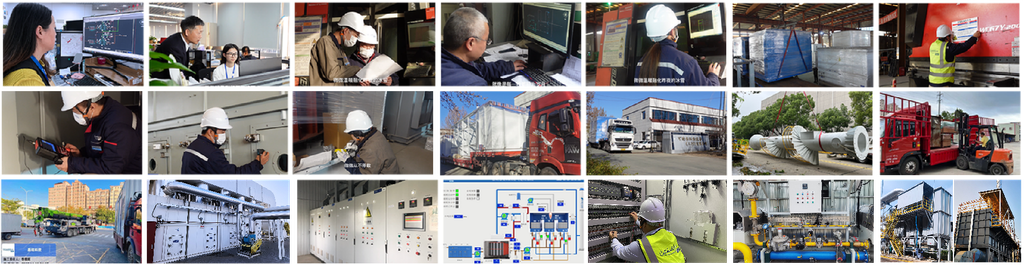
4. How to Select a Semiconductor Exhaust Gas Treatment Supplier?
Choosing a semiconductor exhaust gas treatment supplier requires evaluating more than equipment specifications or individual product prices.
For wafer fabrication, semiconductor packaging, and testing facilities, manufacturers should consider several important factors.
4.1 Semiconductor Industry Project Experience
Semiconductor manufacturing and packaging processes involve different production conditions and exhaust compositions.
Experience in semiconductor-related applications can help suppliers better understand the requirements of wafer manufacturing, advanced packaging, testing, and supporting equipment production.
4.2 VOC Composition and Process Engineering Capabilities
Different organic compounds, such as IPA, acetone, and aromatic hydrocarbons, have different treatment characteristics.
A qualified supplier should be able to evaluate exhaust composition, airflow, operating conditions, and process requirements before selecting suitable combinations of adsorption, concentration, and oxidation technologies.
4.3 Core Equipment Design and Manufacturing
The performance of an industrial VOC treatment system depends on the coordination of its individual components.
In-house equipment design and manufacturing capabilities can help improve integration between zeolite rotor concentrators, RTO systems, and other treatment units.
4.4 Integrated Project Delivery
Process design, equipment manufacturing, installation, commissioning, and subsequent operation and maintenance all contribute to the long-term performance of an industrial exhaust gas treatment system.
Manufacturers should therefore evaluate whether a supplier has the engineering capabilities to support the complete project lifecycle.
5. CADAIR: Industrial VOC Abatement Solutions for Semiconductor Manufacturing
CADAIR specializes in industrial VOC abatement and organic waste gas treatment, providing integrated services covering engineering design, equipment manufacturing, project construction, and operation and maintenance.
With experience across multiple industrial sectors, CADAIR provides VOC treatment solutions for semiconductor and electronics manufacturing applications, including:
- Semiconductor Equipment Manufacturing
- Chip Manufacturing
- Wafer Fabrication
- Semiconductor Packaging and Testing
- Display Panel Manufacturing
- PCB Manufacturing
CADAIR’s technology portfolio includes:
- Zeolite Rotor Concentrator: For VOC adsorption and concentration.
- Regenerative Thermal Oxidizer (RTO): For thermal oxidation of concentrated organic exhaust.
- Thermal Oxidizer (TO): For industrial waste gas oxidation treatment.
- Catalytic Oxidizer (CO): For catalytic oxidation applications.
- Regenerative Catalytic Oxidizer (RCO): Combining catalytic oxidation with heat recovery.
Depending on exhaust gas composition, airflow, concentration, and operating conditions, CADAIR develops customized treatment configurations for different industrial applications.
The Guangdong Xincheng Hanqi wafer-level advanced packaging project demonstrates CADAIR’s experience in semiconductor VOC treatment, particularly in two-stage zeolite rotor concentration, RTO integration, and overall engineering implementation.
For semiconductor manufacturers seeking a semiconductor exhaust gas treatment supplier or an industrial VOC abatement contractor, CADAIR offers project experience and integrated engineering capabilities to support application-specific exhaust treatment requirements.
Looking for a semiconductor VOC treatment solution?
Contact CADAIR to discuss your industrial exhaust gas characteristics, treatment requirements, and project engineering needs.
Website: https://www.cadair.net
Email: admin@cadair.net
Frequently Asked Questions (FAQ)
What is semiconductor exhaust gas treatment?
Semiconductor exhaust gas treatment refers to the collection and treatment of industrial exhaust generated during semiconductor manufacturing, wafer fabrication, packaging, and testing. Depending on the exhaust composition, treatment technologies may include adsorption, zeolite rotor concentration, thermal oxidation, and other suitable processes.
What VOCs are commonly generated during semiconductor packaging?
Depending on the production process, semiconductor packaging and testing facilities may generate exhaust containing organic solvents such as isopropyl alcohol (IPA), acetone, aromatic hydrocarbons, cyclohexane, and xylene.
Why are zeolite rotor concentrators used in semiconductor VOC treatment?
Zeolite rotor concentrators use adsorption and desorption to concentrate VOCs from large-volume, low-concentration exhaust streams. This reduces the airflow entering downstream oxidation equipment and helps improve overall system integration.
Can zeolite rotor concentrators be combined with RTO systems?
Yes. Zeolite rotor concentration and regenerative thermal oxidation can be integrated into a combined VOC treatment system. The rotor concentrates VOCs into a smaller airflow, while the RTO serves as the downstream oxidation unit. The configuration should be determined according to the actual exhaust characteristics and project requirements.
What should semiconductor manufacturers consider when selecting a VOC treatment supplier?
Important considerations include semiconductor industry experience, VOC composition analysis, process engineering capabilities, equipment manufacturing, system integration, and project implementation capabilities.
Does CADAIR provide integrated semiconductor exhaust gas treatment solutions?
Yes. CADAIR provides industrial VOC abatement solutions covering process engineering, equipment manufacturing, project construction, and operation and maintenance. Its technology portfolio includes zeolite rotor concentrators, RTO, TO, CO, and RCO systems.