Project Overview
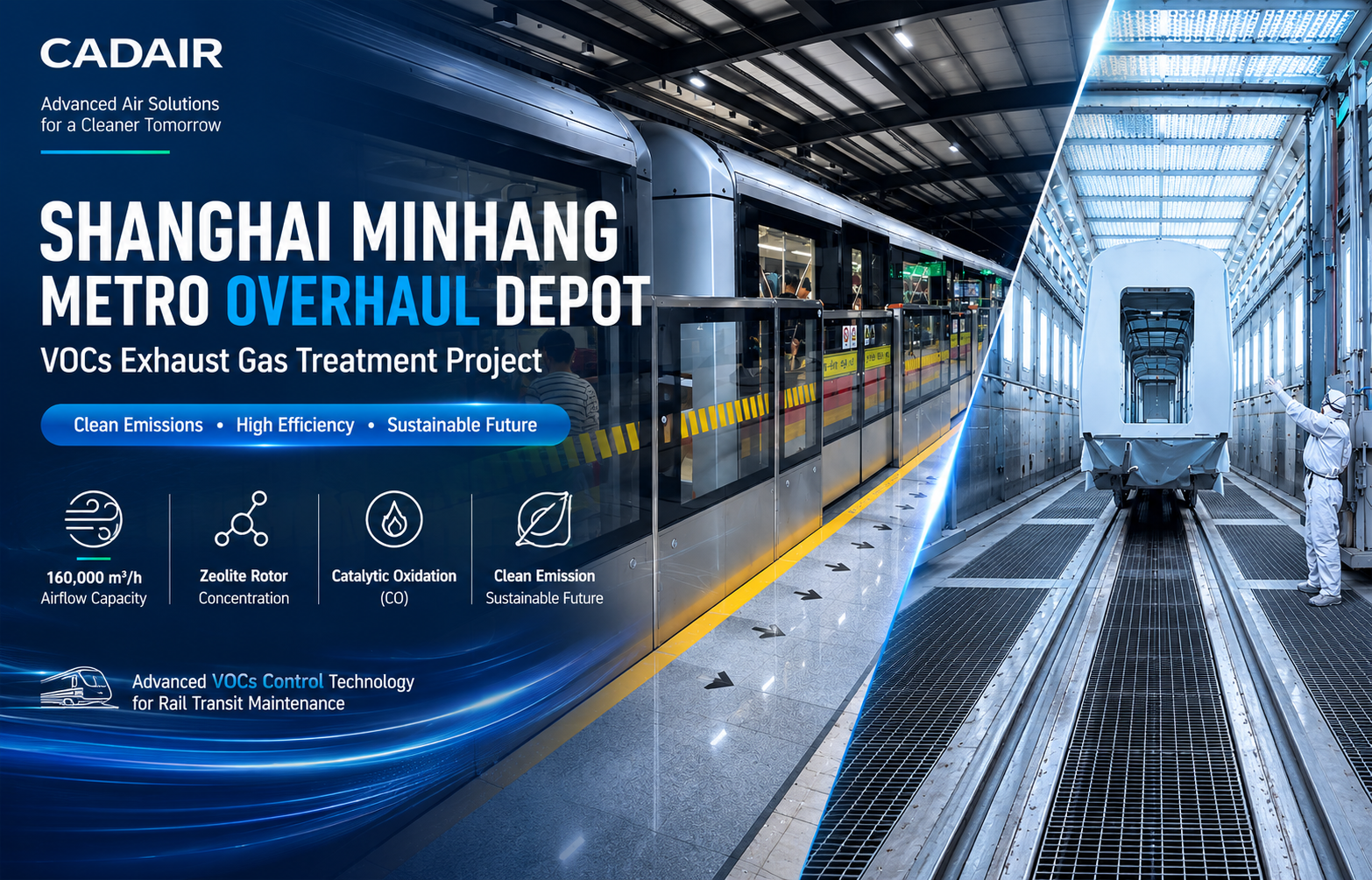
The Shanghai Minhang Metro Overhaul Depot is responsible for the major maintenance and refurbishment of metro trains. During processes such as paint removal, coating, spraying, and drying, significant amounts of Volatile Organic Compounds (VOCs) are generated.
To comply with increasingly stringent environmental regulations and emission standards, the depot initiated an exhaust gas treatment upgrade project and ultimately adopted KEDAIR’s Zeolite Rotor Concentration + Catalytic Oxidation (CO) solution.
Project Challenges
The metro train overhaul workshop presented several challenges for industrial air pollution control:
- Large exhaust airflow volume, requiring a high-capacity treatment system
- Complex VOCs composition, including Toluene, Xylene, and Ethyl Acetate
- Fluctuating pollutant concentrations during different production stages
- Continuous operation requirements with strict environmental compliance standards
Key Technical Specifications
| Parameter | Specification |
|---|---|
| Airflow Capacity | 160,000 m³/h |
| VOC Components | Toluene, Xylene, Ethyl Acetate, etc. |
| Inlet VOC Concentration | 200–300 mg/m³ |
| Concentration Ratio | 20:1 |
| Treatment Technology | Zeolite Rotor + Catalytic Oxidation (CO) |
VOC Treatment Process
1. Pre-treatment System
The exhaust gas first enters a pre-treatment unit, where paint mist, dust, and high-boiling-point contaminants are removed. This process protects downstream equipment and ensures long-term operational stability.
Key Benefits
✔ Removal of paint overspray and particulate matter
✔ Protection of the zeolite rotor system
✔ Improved overall treatment efficiency
2. Zeolite Rotor Adsorption and Concentration
The purified exhaust gas is directed into a Zeolite Rotor Concentrator, where VOC molecules are effectively captured by the zeolite media.
The cleaned air is discharged through the stack after meeting environmental emission requirements.
Key Benefits
✔ High VOC adsorption efficiency
✔ Suitable for large-volume, low-concentration exhaust streams
✔ Significant reduction in operating costs
3. Thermal Desorption Regeneration
A hot air stream at 150–180°C regenerates the saturated zeolite rotor, desorbing and concentrating the captured VOCs into a smaller airflow volume.
Key Benefits
✔ Continuous operation capability
✔ Efficient VOC concentration process
✔ Reduced energy consumption in downstream treatment
4. Catalytic Oxidation (CO) Treatment
The concentrated VOC stream enters a Catalytic Oxidation (CO) System, where organic pollutants are oxidized at 300–350°C.
Under catalyst action, VOCs are converted into:
- Carbon Dioxide (CO₂)
- Water Vapor (H₂O)
The treated gas is then safely discharged.
Key Benefits
✔ High VOC removal efficiency
✔ Lower operating temperature than thermal oxidation
✔ Reduced energy consumption
5. Zeolite Rotor Reuse and Continuous Operation
After regeneration, the zeolite rotor returns to the adsorption stage and continues operating in a continuous cycle.
Key Benefits
✔ Long equipment service life
✔ Stable treatment performance
✔ Reduced maintenance requirements
Project Results
Following project commissioning, multiple rounds of testing conducted by independent third-party agencies confirmed that:
- VOC emissions consistently met regulatory standards
- Compliance with Shanghai environmental emission requirements
- Significant reduction of environmental compliance risks
- Reliable support for long-term metro depot operations
Project Value
This project has become a benchmark VOCs treatment case study in China’s rail transit maintenance industry.
By integrating Zeolite Rotor Concentration Technology with Catalytic Oxidation (CO), KEDAIR successfully solved the challenge of treating large-airflow, medium-concentration coating exhaust gases.
The project demonstrates the effectiveness of advanced VOC control technologies in the rail transportation sector and provides a replicable, scalable, and sustainable environmental solution for metro maintenance facilities worldwide.