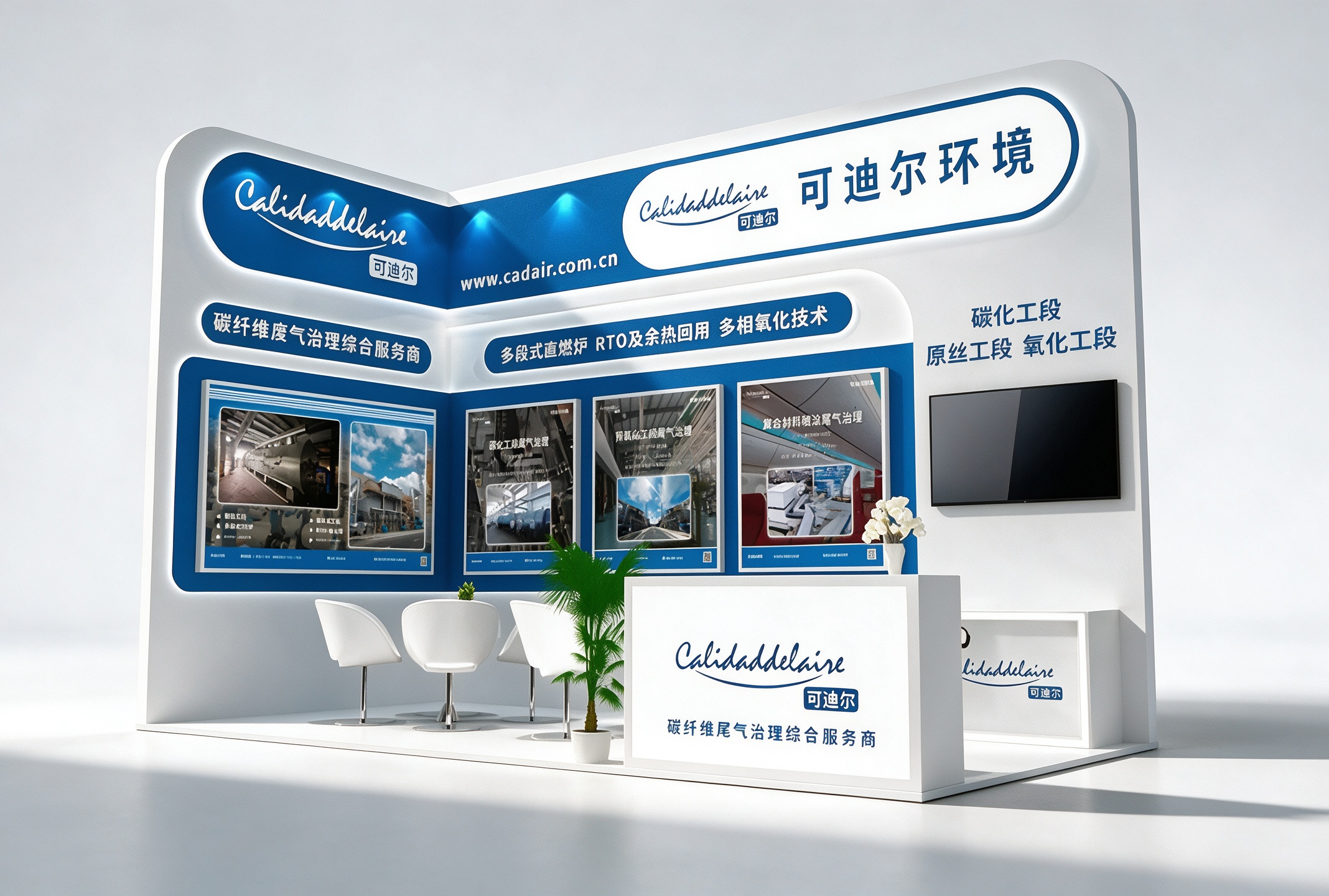
Shanghai, China — September 3, 2026 — The 29th China International Composites Industrial Technology Exhibition (China Composites Expo 2026) concluded today at the National Exhibition and Convention Center (Shanghai). During the three-day exhibition from September 1–3, CADAIR showcased its industrial exhaust gas treatment technologies for carbon fiber production and composite materials manufacturing, including multi-stage Thermal Oxidizers (TO), Regenerative Thermal Oxidizers (RTO), and zeolite rotor + RTO systems.
As carbon fiber and advanced composite materials manufacturing capacity continues to expand, effective exhaust gas treatment has become an important consideration for new production lines, capacity expansion, and environmental compliance upgrades.
Carbon fiber production can generate complex exhaust streams containing tar, hydrogen cyanide (HCN), acrylonitrile (ACN), and various VOCs. Operating conditions can also vary significantly in terms of temperature, airflow, and pollutant concentration. These characteristics can create challenges for conventional single-stage combustion systems, including fouling and blockage, NOx formation, and insufficient treatment performance.
At China Composites Expo 2026, CADAIR presented different treatment routes for different process conditions rather than applying a single technology across all carbon fiber and composite manufacturing applications.
Three Treatment Technologies for Different Carbon Fiber and Composite Processes
Multi-Stage TO: Designed for Complex High-Temperature Carbonization Exhaust
Carbonization is one of the most challenging exhaust treatment stages in carbon fiber manufacturing due to its high temperature, tar-containing exhaust, toxic compounds, and complex pollutant composition.
CADAIR’s multi-stage Thermal Oxidizer is designed with four functional reaction zones:
- Mixing and combustion zone
- Reducing reaction zone
- Cooling zone
- Re-oxidation zone
Through its staged reaction and flow-control structure, different components in the exhaust can be treated progressively. Partial decomposition takes place in the initial combustion stage, followed by NOx reduction in the reducing zone. After controlled cooling, remaining combustible pollutants undergo deep oxidation in the re-oxidation stage.
The system can achieve a reported pollutant removal efficiency of over 99.5% under designed operating conditions, while its staged combustion configuration is designed to help control NOx formation and accommodate high-temperature exhaust containing tar.
For carbon fiber plants, the system can also be integrated with waste heat recovery, allowing high-temperature exhaust heat to be recovered and reused in production processes, helping reduce overall energy consumption.
RTO: Stable VOC Abatement for Medium-to-Large Airflows
For carbon fiber pre-oxidation and other processes generating medium-to-large airflow with relatively low VOC concentrations, Regenerative Thermal Oxidizers (RTOs) provide another treatment option.
An RTO uses regenerative ceramic heat storage media to recover heat from treated exhaust. CADAIR’s RTO systems can achieve approximately 95% heat recovery efficiency, reducing auxiliary fuel consumption during operation.
Under suitable VOC concentration and operating conditions, the system can support autothermal operation while simultaneously enabling waste heat recovery.
This makes RTO technology suitable for applications requiring long-term and stable VOC abatement, including carbon fiber pre-oxidation exhaust treatment.
Zeolite Rotor + RTO: An Energy-Efficient Route for High-Volume, Low-Concentration VOCs
Composite materials spray coating and coating processes can generate very large airflow volumes with relatively low VOC concentrations.
For these applications, CADAIR combines a zeolite rotor concentrator with an RTO.
The zeolite rotor first adsorbs and concentrates VOCs from the high-volume exhaust stream. The concentrated VOC stream is then desorbed into a significantly smaller airflow and sent to the RTO for thermal oxidation.
This process converts a large-volume, low-concentration exhaust stream into a smaller-volume, higher-concentration stream, reducing the required capacity of downstream thermal oxidation equipment.
The integrated Zeolite Rotor + RTO configuration can therefore help reduce equipment size and associated capital and operating costs for applications such as:
- Composite materials spray coating
- Composite materials coating and finishing
- Large-scale coating production lines
- Other high-volume, low-concentration VOC applications
Engineering Experience Across Carbon Fiber and Composite Materials
Technology selection for carbon fiber exhaust gas treatment depends heavily on actual process conditions, pollutant composition, airflow, temperature, VOC concentration, and operating patterns.
CADAIR has established engineering experience across carbon fiber and composite materials applications, with projects covering pre-oxidation, carbonization, spray coating, and coating processes.
Selected project references include:
Guangdong Heley Chemical Technology Co., Ltd.
- Pre-oxidation and carbonization exhaust treatment
- RTO airflow: 22,400 m³/h
- Multi-stage TO airflow: 1,150 m³/h
ZHONGFU SHENYING CARBON FIBER CO.,LTD.
- Exhaust treatment for production lines No. 2, 3, 5, and 6
- RTO: 50,000 m³/h × 4 units
- Multi-stage TO: 1,050 m³/h
Boeing Tianjin Composites Co., Ltd.
- Composite materials spray coating exhaust treatment
- Zeolite rotor airflow: 500,000 m³/h
- RTO airflow: 18,000 m³/h
These projects cover different airflow ranges and process conditions, providing CADAIR with practical engineering experience in the application of TO, RTO, and zeolite rotor concentration technologies.
CADAIR also provides intelligent operation and maintenance capabilities, enabling operating data to be monitored and controlled digitally to support equipment management and long-term system operation.
From Process Assessment to Long-Term Operation
For carbon fiber and composite materials manufacturers, exhaust treatment requirements can vary significantly between a new production line and an existing facility undergoing an environmental upgrade.
CADAIR provides an integrated service covering:
Process and exhaust assessment → Treatment process design → Equipment manufacturing → System installation → Commissioning → Operation and maintenance
The solutions can be applied to:
- New carbon fiber production lines
- Pre-oxidation exhaust treatment
- Carbonization exhaust treatment
- Existing exhaust treatment system upgrades
- Composite materials spray coating
- Composite materials coating processes
- High-volume, low-concentration VOC exhaust treatment
By matching treatment technology with the actual process conditions, CADAIR aims to provide stable, application-specific exhaust gas treatment rather than relying on a one-size-fits-all approach.
CADAIR at China Composites Expo 2026
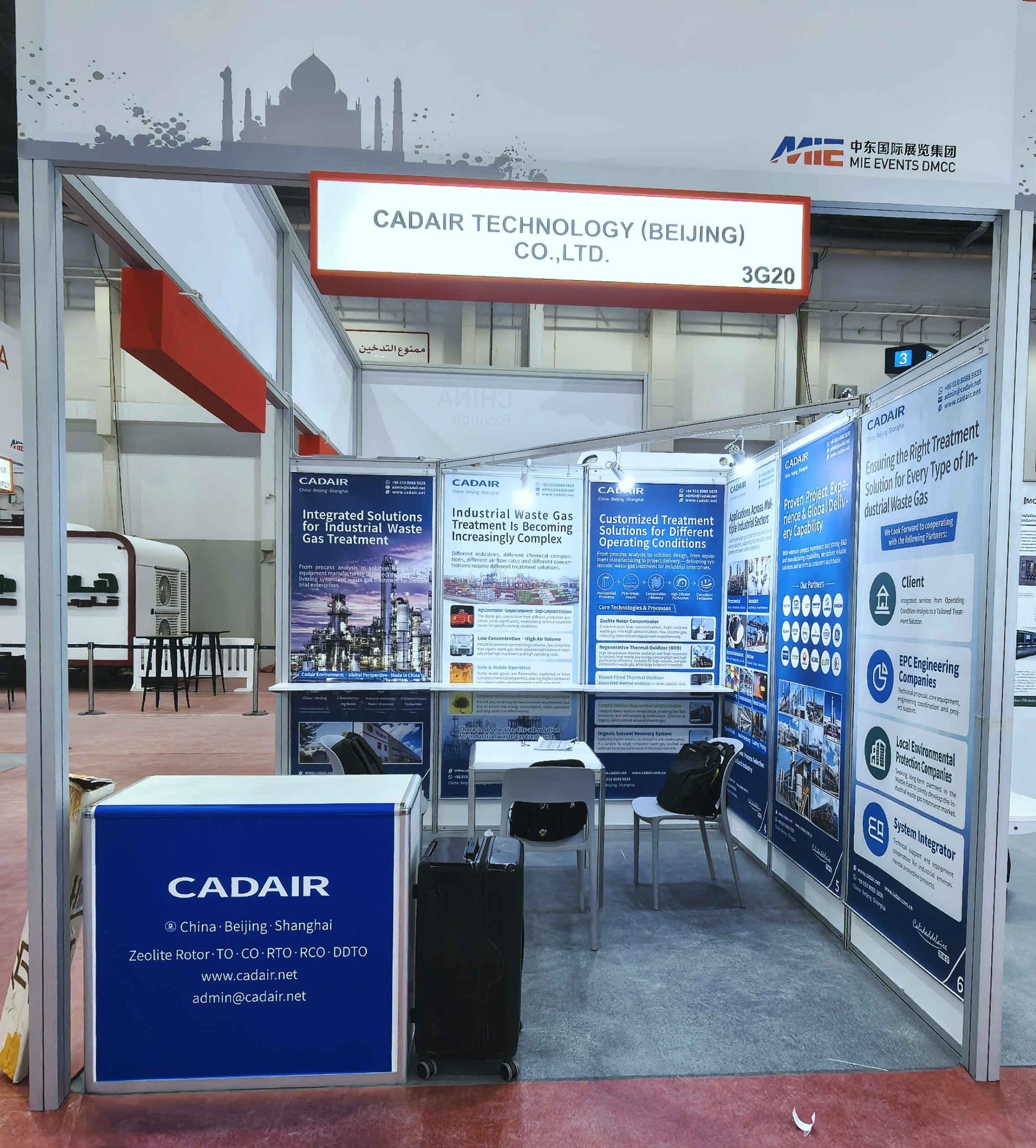
From September 1–3, CADAIR met with industry professionals at Booth Z18, Hall 6.1, National Exhibition and Convention Center (Shanghai) during China Composites Expo 2026.
The exhibition provided an opportunity to discuss the evolving environmental challenges associated with carbon fiber manufacturing, carbonization exhaust, pre-oxidation exhaust, composite materials coating, and VOC abatement.
Although the exhibition has now concluded, CADAIR will continue to support carbon fiber and composite materials manufacturers with customized exhaust gas treatment solutions based on actual process conditions and project requirements.
CADAIR — Industrial Exhaust Gas Treatment Solutions for Carbon Fiber and Composite Materials.